Author: Tressie Taylor

  • When Language Still Isn’t Improving: The Missing Link Most Parents Never Hear About

    When Language Still Isn’t Improving: The Missing Link Most Parents Never Hear About

    Abnormal Electrical Activity in Autism and When to Get a 24-Hour EEG.

    But what if you did all of that…
    and language still isn’t coming?
    Or worse… what if your child said a few new words and then lost them?

    If that’s happening, you are not alone — and you are not imagining it.
    This Part 2 guide explains the biggest, most overlooked reason language doesn’t improve with detox alone:

    Abnormal electrical activity in the brain (EA = Electrical Abnormalities).

    And if you’ve never heard of it — don’t worry most parents haven’t.
    Many pediatricians don’t mention it and therapists rarely talk about it.

    But once you understand EAs, everything suddenly makes sense.

    Let’s walk through the signs, the science, the real-life examples, and what to do next.


    The Truth No One Tells Parents: Language Should NOT Take Years to Improve

    After helping hundreds of parents complete thousands of rounds of chelation, here’s the pattern:

    If language is going to improve because of detox, you see early sparks within 10 rounds.

    Not full sentences or overnight miracles.

    But something for example:

    • new sounds
    • attempts to imitate
    • more babbling
    • increased engagement
    • more vocal play
    • better receptive language

    These “green shoots” show that detox is lowering the interference enough for the brain to try language.

    So what does it mean when:

    • nothing changes after 10 rounds, or
    • you see a few new words… and then lose them, or
    • every good week is followed by a crash to baseline?

    It means chelation is working —
    but something else is overriding the progress.

    And that “something else” is most often abnormal electrical activity.


    What Are Electrical Abnormalities (EA)?

    Here’s the simplest explanation:

    EA is seizure-like misfiring in the brain that never turns into full seizures but still disrupts language, learning, behavior, sleep, and processing.

    It does not look like the seizures you see on TV.
    There is no shaking or collapsing. In fact there are no obvious external signs at all.

    In fact, many kids with EA have zero visible seizures, yet their EEG shows electrical patterns that interfere with communication and development.

    This matches the medical literature too:

    ✔ A major study found that 91 percent of children with abnormal EEG discharges had speech and language disorders.
    ✔ Only a small percentage had visible seizures.

    Parents miss it.
    Doctors miss it.
    Schools miss it.
    And kids struggle unnecessarily.

    But once you know what to look for, the signs become unmistakable.


    The Signs of Abnormal Electrical Activity (EA)

    These patterns are so reliable I can often spot EA without ever meeting the child.

    Here are the major signs — explained in parent-friendly language.


    1. No Language Improvement After 10–12 Rounds of Chelation

    This is the biggest red flag.

    If detox were the only barrier, some language movement would have shown up by now.

    When nothing changes, it usually means:

    • the brain is trying
    • but EA patterns are blocking the signals

    Chelation is still helpful—but EA needs to be addressed for language to fully unlock.


    2. Peekaboo Language

    Words or progress appear… then disappear completely.

    This is one of the defining signs of EA.

    • Your child says “ball” for the first time.
    • The next day they say it again.
    • You celebrate.
    • And then…
      It’s gone.

    It differs from the normal peek-a-boo gains we see in chelation. In chelation, a new skill comes and goes before it finally stays forever. In EA the words don’t come back again.

    Days go by. Weeks.
    The progress disappears—not reduced, not inconsistent—gone.

    This appear-vanish pattern is not normal for detox kids.
    It is classic EA.

    Why?

    Because EA interferes with memory consolidation—the brain cannot “hold” new skills.


    3. The “Spark and Crash” Response to New Interventions

    This one fools almost everyone.

    Your child tries something new:

    • a diet
    • a supplement
    • a therapy
    • a detox protocol

    And for the first 2–3 days, you see WILD progress.

    You think:
    “Finally! This is it!”

    And then…
    everything goes back to baseline.

    Not slowly or subtly, but sharply. There one day and gone the next. the pattern is the same with every new intervention you try.

    This is another hallmark of EA:

    • the brain fires correctly for a short burst
    • then misfires again
    • and the skill is lost

    Parents often spend YEARS chasing these “good first days” over and over without realizing the underlying cause.


    4. Overnight Regression

    If new skills are gained during the day but lost after sleep, that strongly suggests nighttime electrical activity.

    This is why a standard 20-minute EEG is usually useless—it misses nighttime patterns.


    5. Subtle Absence Episodes or Staring Spells

    Even if they’re brief or inconsistent, these are meaningful.

    Research shows 64 percent of children with discharges had subtle staring episodes once parents were asked structured questions. In Absence episode a child stares off and you can’t get their attention or pull them out of it. Once over it’s like it never happened, your child just lost time.

    These can be difficult to see because they can last for as little a seconds. They can even be happening during sleep.


    Why EA Blocks Language (The Simplest Explanation Possible)

    Language requires:

    • stable neural firing
    • consistent memory consolidation
    • uninterrupted communication between brain regions

    EA disrupts these.

    Think of it like static on a radio:

    • the words are there
    • the brain is trying
    • but the message gets “scrambled”
    • nothing sticks

    So the child:

    • can’t hold onto new vocabulary
    • struggles to retrieve words
    • loses progress at night
    • can’t build on skills
    • hits plateaus that last months or years

    Chelation helps by lowering the toxic load. However, if EA is present, the brain still can’t stabilize enough to form language.

    This is why EA must be addressed for a subset of kids.


    Real Story: The Mom Who Lost and Found Language

    A mom in my program told me:

    “Rounds 1–3 were amazing. He tried new sounds. He started babbling again. He even said ‘up.’

    By round 5… nothing. Everything disappeared. I thought I ruined him.”

    She didn’t ruin anything. After we talked about exactly what she saw it became clear that his brain was misfiring at night.

    The first weekend of chelation pushed the brain enough to fire correctly, so she saw language.

    Then the EA pattern “pulled” him back.

    After a 24-hour EEG and a low-dose EA medication, his language stabilized. From there, each round of detox built on the previous one.

    This is what happens when you address the real barrier.


    You Need the RIGHT EEG: A 24-Hour EEG (Not a 20-Minute One)

    This is one of the most important things in the entire guide.

    A 20-minute EEG misses 80–90 percent of abnormal patterns.

    Why?

    • Many discharges happen during sleep
    • Some only appear during transitions
    • Some appear only intermittently
    • Kids may not misfire during the appointment window

    This is why so many parents hear:
    “Everything looks normal,”
    and walk away with no answers.

    Only a 24-hour EEG reliably catches the patterns associated with:

    • language regression
    • developmental plateaus
    • attention issues
    • sleep disturbances
    • behavioral swings

    If possible, ask for:

    • a 24-hour ambulatory EEG
    • with sleep included
    • and a full written interpretation

    What the EEG Report May Say (Even If the Doctor Says It’s “Normal”)

    Doctors often report EEGs as “normal” unless there are obvious spikes or full seizure activity. What they mean is ‘normal for a child with developmental delays’.

    Every child with developmental issues DOES NOT have EA. So even though they say it’s “normal” you can read the signs yourself in the interpretive report.

    It may include phrases like:

    • “Diffuse slowing”
    • “Abnormal background activity”
    • “Multifocal discharges”
    • “Abnormal alpha rhythm”
    • “Beta asymmetry”
    • “Requires clinical correlation”

    These are meaningful, they matter.
    And these absolutely can affect language.

    If you see ANYTHING in the report that is not “completely normal background,” you should follow up with a neurologist. You can discuss doing a trial of AEDs for language.


    How Anti-Epileptic Drugs (AEDs) Can Help Children With Language Delays

    Not every child needs medication.
    But when EA is significant and blocking development of language, medication can be transformative.

    This is not about giving your child a drug “just in case.”
    This is about responding to clear, measurable neurological misfiring.

    The research I linked earlier found:

    70 percent of children improved within ONE CLINIC VISIT after starting EA medication.

    Improvements included:

    • expressive language
    • receptive language
    • attention
    • behavior
    • sleep
    • memory
    • processing

    That is a massive response rate. Not only that but they are measurable responses. You aren’t relying on feelings, but clear observation of new sounds and meeting language milestones.

    Which medications have this potential?

    Here are the most commonly used ones in practice:


    1. Valproic Acid (Depakote)

    Strongest evidence base for language-impacting discharges.

    Pros:

    • broad-spectrum
    • effective for nighttime discharges
    • used in many EA-responsive kids

    Cons:

    • requires liver monitoring
    • can affect folate pathways

    2. Lamotrigine (Lamictal)

    Very effective for generalized discharges and subtle EEG abnormalities.

    Pros:

    • high language response
    • well tolerated
    • supports mood

    Cons:

    • must be increased slowly
    • watch for rashes

    3. Levetiracetam (Keppra)

    Some kids do extremely well.
    Some do terribly.

    Pros:

    • effective for many seizure types
    • widely available

    Cons:

    • can cause irritability or aggression in a subset
    • Consider adding B6

    4. Gabapentin

    Gentle and safe but not effective for most seizure types.
    Sometimes used when parents are nervous about stronger meds.


    How to Work With a Neurologist (Scripts + Tips)

    Many parents feel intimidated at EEG appointments or unsure how to advocate.

    Here is a simple, confident script you can use:

    When requesting the EEG:

    “My child has language delays and developmental regression patterns consistent with abnormal electrical activity. We are specifically requesting a 24-hour EEG with sleep included because short EEGs miss nighttime discharges.”

    If the neurologist dismisses your concerns:

    “There’s emerging evidence that subclinical discharges can significantly impact language even without visible seizures. We would like to rule this out with the appropriate testing.”

    If the doctor says the EEG is normal but the report says otherwise:

    “I see the report mentions abnormal background activity. Can you please explain how that relates to cognition and language pathways?”

    You are not being difficult.
    You are advocating effectively.


    Can You Continue Chelation if Your Child Has EA?

    Yes—once your child has started AEDs you can restart ACC.

    Chelation does NOT cause seizures — but it can lower the threshold in a child who already has electrical instability.

    So the rule is:

    1. Identify EA
    2. Stabilize with medication if needed
    3. Resume chelation at a comfortable pace
    4. Monitor with your neurologist

    Many kids make more language progress on chelation once EA is under control.


    Practical Tips for Parents Navigating EA

    1. Track behavior morning vs evening

    EA kids often lose progress after sleep.

    2. Film short episodes of staring or zoning out

    Neurologists often take these seriously.

    3. Keep a regression log

    Note when and how skills disappear.

    4. Bring the study with you

    5. Trust your gut

    Parents are usually right when something feels “off.”


    When to Move to EA Evaluation: Simple Rule

    If your child:

    • is 10+ rounds into chelation
      AND
    • has no language progress
      OR
    • shows peekaboo language
      OR
    • loses skills overnight
      OR
    • improves for 1–3 days and then crashes

    …it is time for a 24-hour EEG.

    No waiting.
    No “let’s see.”
    No “maybe after six more months.”

    Your child’s brain is developing NOW.
    Language circuits are wiring NOW.
    Do not lose time.

    You’re not being dramatic.
    You’re being thorough.


    Key Takeaways

    • If language does not improve after 10 to 12 rounds of chelation, look at abnormal electrical activity
    • Peekaboo language and overnight loss of skills are classic EA patterns
    • A 24 hour EEG is far more useful than a 20 minute one
    • When EA is treated, detox and supplements start working again

    Get Clear — EA-Aware Supplement Strategy

    If you’re reading this and thinking:

    “This might be my child… but I don’t know where to start.”

    I can help.

    In a Get Clear: Supplement Strategy Session, we will:

    • Review your child’s language plateau
    • Identify EA red flags
    • Build a supplement plan that considers electrical stability
    • Determine what to try before or after EEG
    • Clarify your next 30–60 days of action
    • Remove the guesswork and overwhelm
    • Discuss ways to approach your child’s doctor about getting a trial of AEDs

    Language progress is possible.
    You just need the right map.

    You do not have to navigate this alone.

  • Effective Strategies to Enhance Your Child’s Speech | Supporting Language During Detox

    Effective Strategies to Enhance Your Child’s Speech | Supporting Language During Detox

    A clear, step-by-step guide to boosting language while supporting your child’s detox journey.

    When your child struggles with language, there’s a particular kind of ache that settles into your days. You keep hoping this will be the week they try a new sound. You wonder if that babble meant something. You lean in when they take a breath, hoping a word will escape.

    You’re doing everything—the diets, the supplements, the round after round of chelation. However, language still isn’t coming the way you hoped.

    And you’re left thinking:

    What am I missing?
    What else can I try?
    Why isn’t this helping language the way it seems to help other kids?

    If you’ve ever felt that way, this guide is for you.

    This isn’t a list of random supplements.
    It’s not a “try everything and hope” post.

    This is a structured, grounded, experience-based roadmap for supporting language during detox — especially in the early stages.

    Over the last 15+ years, I have worked with thousands of parents. During this time, I’ve learned there are certain steps that reliably support language. There are also certain signs that tell you when to pivot.

    This guide gives you all of it.


    Why Language Often Improves Early in Chelation — And Why This Matters

    One of the most persistent myths in the detox world is that “language comes last.”

    Not true.

    If clearing metals alone will solve your child’s communication delays, you will notice a shift within the first 10 rounds of chelation. It might even occur within the first few rounds.

    This matches what we see clinically and what I’ve seen in my own family and students for over a decade.

    Here are the early clues that chelation is waking the brain:

    • More vocal play
    • Trying new sounds
    • More babbling
    • Attempted imitation
    • Better receptive language (following directions, responding to name)
    • More engagement
    • More eye contact or shared enjoyment
    • A new syllable or proto-word
    • More interest in social games

    These might seem small, but they’re real.
    They’re the foundation of expressive language.

    If those sparks don’t show up by round 10–12, something else is suppressing language.

    It doesn’t mean you’re doing chelation wrong.
    It doesn’t mean chelation isn’t working.
    It simply means there are other barriers you need to address while detox continues in the background.

    And those barriers are fixable — often quickly.

    But first, you need to understand what they are.


    Why Language Stalls: The Four Most Common Roadblocks

    You can be doing everything “right” and still get stuck.
    Here are the four biggest reasons language doesn’t budge — even with chelation.


    1. Gut Inflammation (The Brain’s Biggest Distractor)

    The gut and brain are in constant communication.
    If the gut is inflamed, irritated, or imbalanced, the brain is too distracted to develop language normally.

    Common gut-related language blockers:

    • chronic gas or bloating
    • loose stools or constipation
    • yeast overgrowth
    • food intolerances
    • leaky gut
    • poor digestion
    • constant tummy aches
    • chronic congestion
    • eczema

    Inflammation signals the brain that “something is wrong.” The brain responds by pulling resources away from higher-level tasks like speech.

    Kids with gut inflammation often show:

    • poor eye contact
    • inconsistent receptive language
    • irritability
    • short attention span
    • lots of stimming
    • emotional volatility
    • sleep disturbances

    Once gut inflammation calms, many parents report:

    • clearer engagement
    • more attempts at communication
    • more imitation
    • fewer meltdowns
    • improved processing

    Gut work isn’t glamorous, but it is ESSENTIAL.


    2. Nutrient Deficiencies (You Cannot Build Language Without Raw Materials)

    Toxic metals interfere with:

    • folate transport
    • B12 utilization
    • fatty acid metabolism
    • mineral balance
    • methylation
    • mitochondria

    So even if you’re feeding your child well, they may not be using those nutrients well. (and lets face it many of our kids are picky eaters with limited food choices. The also contributes to nutrient deficiencies.)

    When kids are nutrient depleted, they struggle with:

    • word retrieval
    • energy
    • attention
    • processing
    • social interest
    • initiation of speech

    Some kids “spark” on folinic acid or B12 because they’re finally getting access to nutrients they’ve been blocked from using.


    3. Nervous System Dysregulation (Fight-or-Flight Kids Struggle to Access Language)

    Think of your child’s nervous system like a dimmer switch.

    When they’re regulated → language circuits turn on.
    When they’re dysregulated → language circuits shut off.

    Signs of dysregulation:

    • morning irritability
    • “zoned out” behavior
    • sensory overwhelm
    • rigid behavior
    • difficulty shifting activities
    • tantrums that seem random
    • trouble falling or staying asleep

    Regulation is the doorway to communication.
    If the nervous system is chaotic, language will be too.


    4. Energy Deficits (Mitochondria Power Speech)

    Language requires a LOT of energy.
    It’s a complex motor-planning, memory, sequencing, emotional-regulation process.

    Kids with mitochondrial weakness often:

    • seem foggy or tired
    • lose skills when fatigued
    • do better in the morning than the afternoon
    • have low tone
    • struggle to imitate
    • take longer to learn new sounds

    Supporting mitochondria can give the brain the energy it needs to learn and keep language.


    Supplements That Meaningfully Support Language

    This is where most parents ask the same question:

    “Which supplements ACTUALLY help language?
    And how long do I try each before giving up?”

    Below is the expanded, practical, mom-tested guide you’ve been needing. This isn’t theory — this is the pattern I’ve seen over and over in real families.


    Folate Therapies: 5-MTHF & Folinic Acid (Leucovorin)

    Folinic Acid (Leucovorin)

    One of the strongest supports for expressive language.

    Best for kids who:

    • imitate but don’t initiate
    • use scripting instead of original language
    • understand more than they can express
    • are “almost there” but can’t access speech
    • have low verbal drive

    Why it works:

    • supports cerebral folate transport
    • boosts acetylcholine
    • improves motivation & initiation pathways
    • helps retrieve and produce language

    Signs it’s working:

    • more spontaneous words
    • more attempts to communicate
    • increased flexibility
    • improved social play
    • new syllables or sounds

    Signs it’s too much:

    • aggression
    • hyperactivity
    • irritability
      (If so: reduce dose or switch to 5-MTHF.)

    Trial length: 1-2 weeks


    5-MTHF (Methylfolate)

    Great for kids who need gentler support or who get activated by folinic acid.

    Best for:

    • sensitive kids
    • mood instability
    • methylation challenges
    • low motivation, low mood

    Trial: 3 days – 1 week


    Methylators Methyl-B12 vs Hydroxo-B12

    Methyl-B12 Supports:

    Powerful for activation, engagement, and expressive language.

    Best for kids who:

    • need more energy
    • are slow to engage socially
    • show limited joint attention
    • need help with initiation

    Hydroxo-B12 Supports:

    Gentler. Great for kids who get “wired” on MB12.

    Best for:

    • COMT kids
    • easily overstimulated kids
    • anxious or hyper-reactive kids

    Signs it’s working:

    • more engagement
    • more sound play
    • better receptive language
    • more attempts to imitate
    • new syllables

    Trial: 3 days – 1 week


    DHA-Heavy Omegas (Crucial for Speech Circuits)

    DHA supports:

    • myelination
    • brain flexibility
    • communication between neurons
    • stable mood
    • articulation pathways

    Best for kids who:

    • have processing delays
    • struggle with articulation
    • “get stuck” in scripts
    • seem slow to respond

    Trial: 2-4 weeks
    (But many parents see subtle changes sooner.)


    Carnitine (ALCAR or L-Carnitine) Energy for Speech

    Carnitine is one of the most underrated language supports.

    Why it helps:

    • increases brain energy
    • improves motor planning for speech
    • reduces fatigue-related regressions
    • stabilizes the afternoon “crash”

    Best for kids who:

    • have low tone
    • get tired easily
    • lose language when fatigued
    • seem foggy or slow to respond

    Trial: 2-4 weeks


    Choline & Phosphatidylserine (The Memory–Language Boosters)

    These support acetylcholine — the neurotransmitter tied to:

    • learning
    • memory
    • processing
    • word retrieval

    Best for kids who:

    • know words but can’t recall them
    • start words but can’t finish
    • freeze mid-sentence
    • understand more than they express

    Trial: 2-4 weeks


    TMG & DMG (The Methylation Movers)

    TMG (Trimethylglycine)

    Stronger activation → great for expressive language.

    DMG (Dimethylglycine)

    Gentler → great for emotional regulation and subtle gains.

    Best for:

    • kids who need a push in expressive language
    • kids who get “stuck” or slow in speech
    • kids who need stabilization AND activation

    Trial: 2–3 days


    SPEAK Oil (Omega-3 + Vitamin E + GLA)

    SPEAK is a speech-focused formulation built around:

    • DHA (the brain’s main lipid for speech)
    • Vitamin E (as an antioxidant)
    • GLA (gamma-linolenic acid, an anti-inflammatory fatty acid)
    • Other supportive lipids

    Some kids do get:

    • More vocalization
    • Clearer articulation
    • Longer phrases
    • More social language

    The benefit usually comes from:

    • High DHA improving myelination
    • GLA balancing inflammatory prostaglandins
    • Some effect on cell membrane fluidity
    • Mild support of neurotransmission

    Trial: 1-2 weeks


    Probiotics Backed by Real-World Results

    Not all probiotics support language — but some do.

    L. reuteri

    Supports:

    • bonding
    • eye contact
    • engagement
    • social communication

    B. longum

    Supports:

    • mood
    • cognitive flexibility
    • emotional stability

    Trial: 4 weeks


    Adrenal Cortex (ACE)

    Stress is often overlooked but massively impactful.

    When adrenals crash, kids lose:

    • Speech endurance
    • Ability to retrieve words
    • Emotional regulation needed for communication

    Gentle options:

    • Vitamin C
    • B5 (pantothenic acid)

    Trial: 3-4 days


    Thyroid Support (when needed)

    Kids with low T3 (even “normal” lows) often have:

    • Slow processing
    • Delayed words
    • Low energy
    • Flat affect

    Safe supports:

    • Selenium
    • Iodine (only if not sensitive)
    • Tyrosine (if tolerated)

    Trial: 4-6 weeks


    Download the Language-Boosting Supplements Cheat Sheet

    This section of the guide is a LOT — supplements, categories, timelines, and signs of improvement.

    To make this easier, I created a one-page quick reference so you know exactly:

    • which supplements support language
    • which kids benefit most
    • how long to trial each
    • how to stack them with chelation
    • signs a supplement is helping
    • signs to stop

    Diet isn’t magic.
    But the right diet can dramatically reduce inflammation and free up the brain to communicate.

    Here are the diets with the strongest results in language-supporting kids:


    Gluten-Free, Casein-Free (GFCF)

    Helps with:

    • receptive language
    • eye contact
    • attention
    • processing

    Why:
    Gluten and casein create opioid-like peptides in sensitive kids → fogginess, spacing out, emotional volatility.

    Timeline: 3–6 weeks


    GFCFSF (Adding Soy-Free)

    Soy can mimic the effects of gluten and casein.

    Best for kids with:

    • mood swings
    • inconsistent receptive language
    • irritability after processed foods

    Timeline: 3–6 weeks


    Low-Glutamate Diet

    This diet helps kids who are:

    • irritable
    • aggressive
    • overstimulated
    • scripting excessively
    • sensory sensitive

    Excess glutamate overstimulates the brain → supporting calm improves language access.

    Timeline: 2–4 weeks


    Low Thiol Diet

    Helps kids with:

    • toe-walking
    • pain
    • sensory defensiveness
    • chronic yeast

    Reducing thiols reduces neuroinflammation.

    Timeline: 2 weeks


    Blood Sugar Stability

    Often overlooked.
    But unstable blood sugar = unstable behavior, mood, and attention.

    Simple fixes:

    • protein + fat at every meal
    • avoid carbs alone
    • reduce juice
    • balanced snacks

    Timeline: 1–2 weeks


    The Correct Language Support Sequence (Stop Guessing)

    Trying everything at once makes it impossible to know what worked.

    Here is the order that gives the most dependable language gains:

    1. Chelation: The Root Cause Fix

    Clears the metals blocking language circuits.

    2. Gut Stability + Blood Sugar

    Supports regulation and reduces inflammation.

    3. Diet Adjustments

    Removes food-based irritants.

    4. Minerals + Foundational Nutrients

    Builds biochemical stability.

    5. Folate + B12 Therapies

    Activates communication pathways.

    6. Cognitive + Methylation Supports

    Fine-tunes speech processing and word retrieval.

    7. Continue Chelation Long-Term

    Language accelerates as metals drop.

    This sequence creates clarity and prevents regression.


    Practical Tips for Parents (Real-Life, Not-Theory)

    1. Trial one supplement at a time

    Otherwise, you won’t know what worked.

    2. Don’t start everything on a Monday

    Mondays are already dysregulating.

    3. Track changes

    Note: mood, engagement, sounds, imitation, sleep.

    4. Expect small wins, not big leaps

    Language grows brick by brick.

    5. Don’t chase every recommendation online

    Stick with a structured plan.

    6. Celebrate the tiny things

    A new consonant is a big deal.
    A new syllable is a breakthrough.
    A new request is progress.

    Language development is not linear — but it is buildable.


    What to Do If You’re Still Not Seeing Language Gains

    If you’ve:

    • completed 10+ rounds
    • supported gut + diet
    • trialed supplements
    • watched closely

    …and language STILL isn’t showing those early sparks?

    It’s time to evaluate abnormal electrical activity. This is a neurological pattern that blocks language. It makes supplements appear effective for a day or two and then they fail.


    Book Your Get Clear Session

    If you’re overwhelmed, stuck, or unsure what to try next, do not worry. You do NOT have to guess your way through this.

    Get Clear: Supplement Strategy Session

    In this one-on-one session, we will:

    • Review your child’s history
    • Identify the blocks affecting language
    • Choose the exact supplements to support speech
    • Build a sequencing plan
    • Create a simple, doable next-step roadmap

    You’ll walk away knowing:

    • what to try
    • what order to try it
    • how long to give it
    • what progress looks like
    • and what to do next
  • Stop Following the Detox All the Big Names Recommend | Safe Detox For Autistic Kids

    Stop Following the Detox All the Big Names Recommend | Safe Detox For Autistic Kids

    His mom sat across from me on Zoom, tears streaming down her face.

    “I did everything they told me. The supplements. The IVs. The cilantro smoothies… and my son got worse. Aggression, night waking, screaming.

    Then they told me it was a detox response—and to push through. And I trusted them.”

    Her voice cracked. “I feel like I broke him. I’m terrified to try anything else now.”

    If you’ve ever felt this way—scared, confused, stuck between wanting to help your child and fearing you’ll make things worse—you’re not alone.

    At least once a week, a parent tells me this exact story.

    They followed the detox protocol everyone was raving about. The one promoted by “big-name” doctors. The one wrapped in glossy branding and glowing testimonials.

    But underneath the marketing? The science didn’t match the promises.

    And their child paid the price.

    This article is my way of putting a stop to that:

    • To the misinformation.
    • To the unnecessary harm.
    • To the guilt you’ve carried for trusting a professional.

    You’ll walk away understanding:

    • Why mainstream detox methods often backfire — especially in neurodivergent kids
    • What’s actually happening in your child’s body when detox goes sideways
    • Why risky methods keep getting recommended anyway
    • What a safe, biochemically sound detox plan actually looks like
    • And how to move forward — even if you’ve tried the wrong thing before

    By the end, I want you to feel safer. More grounded. More empowered.

    Because here’s the truth:

    Bad detox doesn’t mean your child is broken. It means the method was wrong — not your child, and not you.


    Why This Matters So Much (And Why the Fear Runs Deep)

    If you’re a parent navigating autism, ADHD, or sensory processing challenges, you’ve probably felt this emotional tug-of-war:

    “I want to help my child heal…
    but I’m terrified of making things worse.”

    Maybe you’ve:

    • Heard horror stories about detox gone wrong
    • Tried a protocol from a “doctor who specializes in autism”
    • Watched your child regress after a supplement, cleanse, or liver flush
    • Been told to “push through” reactions that felt wrong in your gut
    • Felt paralyzed by contradictory advice online
    • Or blamed yourself for trusting the wrong practitioner

    It shows up in quiet, day-to-day moments:

    • Hesitating before giving a new supplement
    • Panicking when your child’s behavior changes
    • Getting stuck in research mode for months (or years)
    • Feeling like every decision is a minefield
    • Wondering if you’ve already “messed it all up” beyond repair

    And here’s the part that breaks my heart the most:

    Most parents who’ve been hurt by detox protocols weren’t following TikTok tips, blog posts, or random Facebook threads.

    They were following professionals.

    Doctors. Nurse practitioners. Biomed clinics.
    People charging thousands for custom protocols.

    You followed their lead.
    And when things went sideways?
    They blamed your child’s genetics… or your inconsistency… or a “healing crisis.”

    Not the protocol itself.

    So let’s start here:

    It’s not your fault.
    You weren’t reckless.
    You weren’t wrong.

    And this part is hard to say — but important:

    Even the most compassionate biomedical providers were trained inside a system that minimized your concerns and dismissed the possibility of harm.

    That same training now shapes how they approach detox.

    They’re not villains. But the worldview that contributed to your child’s toxic load?
    It can’t be the same worldview we use to guide their healing.

    There is a safe, grounded path forward.
    But first, we need to shine a light on the traps.


    Before you try another “miracle detox”…
    Grab my free guide,
    Detox Myths That Keep Autistic Kids Sick, and learn 5 common mistakes to avoid from day one.


    The Detox Methods Everyone Talks About — and Why They Backfire

    Parents are often stunned when I say this, but here’s the truth:

    Most detox protocols circulating in autism and chronic illness spaces are fundamentally unsafe for children with heavy metal toxicity.

    They sound great.
    They’re marketed beautifully.
    They promise fast results.
    And they often come from credentialed, well-known “experts.”

    But here’s what no one tells you:

    Biochemistry doesn’t care how impressive someone’s credentials are.
    It only cares about what works… and what causes harm.

    Below, I’ll walk you through the most common detox methods parents are urged to try — and the real science behind why these often lead to regression, inflammation, and neurological chaos.

    We’re going to unpack each one, clearly and compassionately — so you can finally separate the hype from what your child’s body actually needs.


    1. IV Chelation (“Fast Detox”)

    This is one of the most commonly recommended — and most harmful — detox methods pushed by big-name biomed doctors.

    It sounds convincing:

    • “Get toxins out FAST”
    • “A few drips and your child will be clearer”
    • “High-dose chelators will pull metals out aggressively”

    But here’s the biochemical reality:

    Your child’s body cannot safely keep up with rapid mobilization.

    High-dose IV chelators dump enormous amounts of heavy metals into circulation at once.
    But the body cannot excrete them at the same speed.

    What happens?
    Redistribution.

    Redistribution means the chelator yanks metals out of storage…
    but instead of being eliminated, they redeposit somewhere new — often in the brain.

    This is why so many parents report:

    • behavioral explosions
    • aggression
    • loss of skills
    • increased stimming
    • sleep disturbances
    • sensory overload
    • anxiety and panic
    • self-injury
    • weeks of regression afterward

    It isn’t “detox.” It’s biochemical chaos.

    Why do professionals still recommend IV chelation?

    Honestly? Because it looks impressive. It feels medical as it requires a prescription. It’s very billable.
    And a child can look calmer afterward — not because they’re detoxed, but because the oxidative crash has numbed their nervous system.

    Safe detox never looks like sedation or massive regression.


    2. Cilantro, Chlorella, and “Natural Binders”

    These are the beloved favorites of natural health circles.

    You’ve probably heard things like:

    • “Just throw some cilantro in a smoothie!”
    • “Chlorella binds metals naturally.”
    • “It’s gentle and plant-based — totally safe!”

    But here’s the hard truth:

    Natural does not automatically mean safe.

    What the science actually says:

    Cilantro is often marketed as a “natural chelator.” But biochemically, it’s unpredictable and risky.

    • Yes, it crosses the blood-brain barrier.
    • Yes, it can mobilize mercury from tissues.

    But that’s where the benefits stop.

    Cilantro doesn’t bind metals tightly enough to hold them.
    It grabs them loosely, then releases them erratically — often after they’ve been stirred up and moved. Instead of safely removing metals, cilantro often causes redistribution — pushing toxins deeper into sensitive tissues like the brain and nerves.

    That’s why so many parents notice:

    • sudden aggression
    • anxiety or mood swings
    • new stimming or sensory issues
    • regressions that feel out of the blue

    It’s not a mystery.
    It’s predictable biochemistry.

    What about chlorella?

    Chlorella is often paired with cilantro in detox smoothies. But here’s the science:

    • It’s not a true chelator.
    • It only binds metals in the gut — weakly and inconsistently.
    • It doesn’t remove metals from cells, blood, or the brain.

    And to make things worse? It’s high in thiols — sulfur compounds that can trigger metal movement without stability.

    When kids react badly to chlorella, it’s often due to:

    • increased gut irritation
    • histamine spikes
    • detox reactions from toxins within the chlorella itself

    Parents will often say:

    “We tried cilantro and chlorella, and my child suddenly seemed anxious, aggressive, or just… not themselves.”

    That’s not rare.
    It’s a common, avoidable pattern when these are used for detox.

    Mobilization without binding = redistribution.
    And redistribution = regression.


    3. Glutathione and NAC Sound Good… but Often Backfire

    This one is especially tricky — because on the surface, it sounds perfectly logical:

    • “If glutathione is low, just give more glutathione.”
    • “If NAC boosts glutathione, give NAC to help detox.”

    It feels intuitive. Supportive. Even gentle.

    But here’s what most parents are never told:

    Low glutathione doesn’t cause toxicity — toxicity causes low glutathione.

    Your child’s glutathione levels drop because the body is burning through it trying to manage oxidative stress and mobilized metals. It’s a response. Not a deficiency.

    So when well-meaning practitioners say:

    • “Let’s boost their glutathione.”
    • “NAC will help them detox more effectively.”

    …they’re missing a critical piece of the biochemistry.

    Why Glutathione and NAC Often Backfire

    Glutathione (and its precursor, cysteine) can form complexes with metals like mercury. These complexes move in and out of cells via transporters like LAT1 and MRP.

    Here’s the issue:

    • If you suddenly raise extracellular glutathione too fast,
    • You increase the concentration gradient,
    • And you can actually pull metals deeper into sensitive tissues — including the brain.

    That’s not detox. That’s redistribution.

    And parents often describe what follows:

    • Sudden emotional crashes or crying
    • Aggression or headbanging
    • New stimming or OCD behaviors
    • Sleep issues and night waking
    • Loss of language or connection

    This is not healing.
    It’s neurological distress.

    NAC Isn’t a Cure-All Either

    NAC does have legitimate medical uses:

    • It saves lives in Tylenol overdoses.
    • It helps thin mucus in lung conditions.

    But for “detoxing metals from years ago”? There’s no solid biochemical rationale for that.

    In fact, many kids with heavy metal burden already run high in cysteine — and giving NAC can push already-strained pathways into overload.

    So Why Do So Many Professionals Still Recommend It?

    Simple: it looks good on paper.

    • “Support what’s low” is an easy-to-sell philosophy.
    • NAC and glutathione show up on lab panels.
    • It feels proactive and non-invasive.
    • And many providers aren’t trained in safe pediatric chelation.

    Plus, after a wave of chelation-related lawsuits in the early 2000s, many doctors became overly cautious — sticking to “supportive” therapies that don’t touch the root issue.

    But the Science Points Elsewhere

    The Adams DMSA study found something powerful:

    When the body successfully begins excreting metals, it naturally increases glutathione to keep pace.

    That means:

    You don’t have to flood the system with glutathione.

    You need to reduce the metal burden safely, so the body can return to normal redox balance and recycle glutathione on its own.

    That’s why the ACC method emphasizes:

    • Vitamin C
    • Vitamin E
    • Omega-3s (like fish oil)
    • Low-dose chelators on a consistent schedule

    These support glutathione recycling, rather than forcing metals to move unpredictably.

    Which is exactly why so many parents say:

    “We saw crashes on NAC and glutathione…
    but once we switched to ACC, it was the first time things actually improved without a fallout.”


    4. Homeopathic Detox (“Natural” Doesn’t Mean Safe)

    Many parents turn to homeopathic detox because it’s marketed as gentle, body-aligned, and supportive of self-healing. Practitioners often describe it as:

    • “Stimulating the body’s energetic pathways”
    • “Encouraging detox using your own biology”

    And I get it.

    When you’ve seen your child spiral after a harsh biomed protocol, or crash from supplements that were supposed to help, the word “natural” feels like a lifeline.

    But here’s what most parents never hear — and desperately need to know:

    Homeopathic detox can mobilize metals — without binding them.

    And when metals move without a strong, stable chelator holding onto them, they don’t leave the body.
    They just relocate. Often to more sensitive places.

    Why This Is So Dangerous (Even If It Sounds Gentle)

    Let’s talk about mercury — one of the most neurologically toxic substances kids with autism, ADHD, and chronic illness are often dealing with.

    Organic mercury (methyl or ethyl forms) crosses the blood-brain barrier with terrifying efficiency. It doesn’t just sneak across — it hijacks amino acid transporters, tricking the brain into pulling it in like a nutrient.

    Once it’s in the brain?

    It converts into inorganic mercury — which:

    • Binds tightly to brain tissue
    • Has no natural exit pathway
    • Accumulates
    • Disrupts neurotransmitters, enzymes, and detox systems

    This is why even small mercury exposures (from fish, vaccines, or environment) can have lasting effects in susceptible kids.

    And this is exactly why moving mercury without binding it is so risky.

    Homeopathic remedies often mobilize mercury — but they don’t bind it.

    So what happens?

    Metals shift out of storage… and re-deposit into more delicate tissue like the brain, nerves, or endocrine system.

    What Parents Report (Over and Over Again)

    This isn’t rare. It’s a pattern.

    After homeopathic detox, parents often tell me:

    • “He started waking up at night again.”
    • “Her emotions were all over the place.”
    • “He seemed disconnected — like he wasn’t in his body.”
    • “She lost words we had just gotten back.”
    • “It felt like something got stirred up… and never settled.”

    These aren’t “strong reactions.”
    They’re predictable consequences of redistribution.

    It’s not because the remedy was too potent.
    It’s because mercury moved — and wasn’t escorted out.

    Why “Natural” Isn’t the Same as Safe

    The body cannot remove inorganic mercury from the brain on its own.

    It needs:

    • A chelator that binds tightly
    • A chelator that can cross the blood-brain barrier
    • A dosing schedule that prevents redistribution

    Homeopathy does none of this.

    Real detox uses chelators like ALA, DMSA, and DMPS — at low, frequent doses timed to their half-lives — to safely escort metals out of the body without leaving them free to wreak havoc.

    That’s why so many families see regression after homeopathic detox…

    …and then finally find stability when they switch to structured, science-backed chelation protocols like ACC.


    The only methods that consistently and safely reduce metal burden — in both body and brain — follow core principles:

    • Low dose
    • Frequent dosing
    • Correct chelator
    • Correct half-life

    That’s why I don’t recommend zeolite, nano-zeolite, or any of their shiny, new iterations.

    They may sound like breakthroughs… but they’ve never delivered the outcomes families truly need.parents are actually searching for.


    6. Liver Cleanses: Why “Flushing” the Liver Backfires in Sensitive Kids

    Liver cleanses are a staple trend in the autism and chronic illness world. Marketed as ways to “clear toxins,” “reset the system,” or “jumpstart detox,” they’re often labeled as natural, ancestral, or essential for “unclogging” the liver.

    But here’s the hard truth:

    Liver cleanses don’t clean the liver — they stress it.

    Most liver flushes rely on:

    • Aggressive herbs
    • Bitter compounds
    • High oil intake
    • Juice fasts
    • Combinations that force the liver to dump bile

    This can create dramatic reactions — headaches, rashes, loose stools, behavior spikes — that get misinterpreted as “detox.”

    But what’s really happening isn’t detox. It’s biochemical overload.

    How the Liver Actually Detoxifies

    The liver clears toxins in two phases — and they must stay in balance:

    Phase 1: Activation
    Transforms toxins into intermediate compounds — but these are often more toxic than what you started with.

    Phase 2: Neutralization
    Attaches molecules like sulfur, glycine, or glutathione to render those intermediates safe and ready for elimination.

    These pathways are designed to work in tandem. But here’s what liver cleanses do:

    They force Phase 1 to speed up dramatically — without strengthening Phase 2.

    That means:

    • A surge of reactive intermediates is created
    • Phase 2 can’t keep up
    • Toxins re-enter circulation
    • Kids crash

    Parents report:

    • Crying spells
    • Aggression
    • Night waking
    • Skin rashes
    • Emotional volatility
    • Sensory overload

    But it’s not detox. It’s overwhelm.

    Why It Hits Neurodivergent Kids So Hard

    Kids with autism, ADHD, and sensory disorders are especially vulnerable here. They already tend to have:

    • Low glutathione
    • Impaired methylation
    • Compromised sulfur pathways
    • High oxidative stress
    • Chronic inflammation

    So when Phase 1 revs up and Phase 2 lags behind, the imbalance widens — and the fallout is immediate.

    This is why so many parents see regressions, flares, and new symptoms after liver cleanses.

    It’s not a “healing crisis.” It’s Phase 2 collapse.

    Your Child’s Liver Isn’t Clogged. It’s Overloaded.

    The liver isn’t stagnant. It’s overworked — doing the best it can with:

    • Limited nutrients
    • Ongoing toxic input
    • Blocked pathways
    • Metal burden
    • System-wide stress

    It doesn’t need a purge. It needs support. That means:

    • Nutrients that rebuild Phase 2 (like glycine, sulfur, glutathione precursors)
    • Calming oxidative stress
    • Gentle bile flow support (not forcing)
    • Reducing the overall toxic load
    • Safe, structured chelation

    Real Detox Starts with Phase 2

    Because Phase 2 is where actual toxin removal happens. Phase 1 just creates intermediates — and if Phase 2 can’t finish the job, those intermediates wreak havoc.

    Safe detox focuses on:

    • Antioxidant protection
    • Mineral and gut stability
    • Steady bile flow
    • Chelators timed to half-life
    • Low, frequent dosing
    • Lowering inflammation system-wide

    That’s what clears toxins without sending the body into a tailspin.

    It’s not about flushing. It’s about flow.

    When you support the liver — instead of pushing it — detox becomes gentle, predictable, and truly healing.

    Simple graphic explaining liver detox phases for kids with heavy metal toxicity

    So Why Do These Detox Methods Look Like They Work (At First)?

    This is one of the most heartbreaking parts to explain.

    Many unsafe detox protocols show short-term “improvements” because:

    1. The child becomes fatigued or sedated by inflammation
      Parents interpret this as calmness.
    2. The nervous system shuts down under oxidative stress
      Parents interpret this as compliance.
    3. The child uses fewer words
      Parents interpret this as reduced scripting—not a loss of access.
    4. A “detox high” lasts 1–3 days
      Then crashes hard.
    5. The practitioner reframes regression as “toxins moving” or a Herxheimer reaction
      So the parent doesn’t get alarmed.

    No one should ever gaslight you about your child’s suffering.

    Regression isn’t detox. It’s harm.

    And now—finally—we get to the part that brings hope.


    If You’ve Tried These Things Before, All Is Not Lost

    Take a deep breath. Let this settle in:

    The fix for bad detox isn’t no detox.
    The fix for bad detox is safe, grounded, biochemically sound detox.

    You didn’t ruin your child.
    They didn’t miss their window.
    You just need an approach that works with the body instead of yanking it around.

    So what does that look like?


    What Safe Detox Actually Looks Like (And Why It Works)

    Safe detox follows the principles laid out in the Andy Cutler protocol (ACC) and “do no harm” guidelines. It’s not based on trends. It’s based on biochemistry.

    Principle 1: Detox Must Happen at the Speed of Excretion

    Children can only eliminate tiny amounts of metals at a time. That’s why we use:

    • Low doses
    • Frequent dosing
    • Precise intervals

    This prevents redistribution—the chaos you see in all the unsafe methods.

    Principle 2: Chelators Must Bind Tightly

    ALA, DMSA, and DMPS form stable bonds.
    Cilantro, glutathione, zeolite? They don’t.

    Stable = safe.
    Unstable = neurological fireworks.

    Principle 3: Protect the Brain Until the Body Is Ready

    ACC waits 3 months post-exposure before starting ALA.
    No other method does this—yet it’s crucial to avoid re-toxifying the brain.

    Principle 4: Support Systems First

    Before you detox, you stabilize:

    • Minerals
    • Stress
    • Digestion

    A foundation makes everything else possible.

    Principle 5: Go Low. Go Slow. Go Steady.

    • No pushing.
    • No “big swings.”
    • No trauma.

    Healing should feel like clouds parting—not like surviving a storm.

    Parents often tell me:
    “This is the first time my child has improved without falling apart.”

    That’s what safe detox feels like.

    Want a step by step path for safe detox?
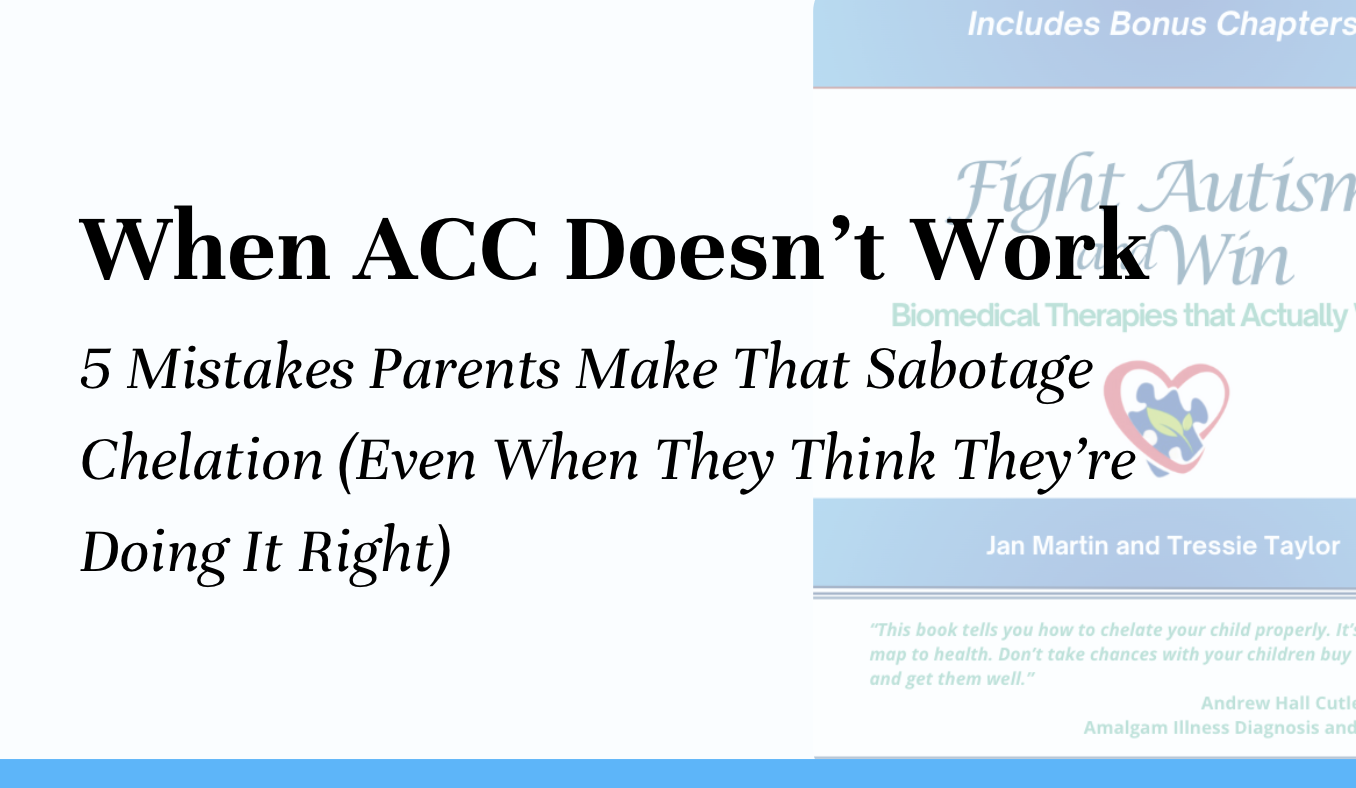
    My book Fight Autism and Win walks you through exactly how we used the ACC protocol to recover my own son.


    Real Families. Real Healing.

    One mom came to us after a MAPS doctor put her son on high-dose glutathione, Nystatin, and cilantro smoothies. He was volatile. Losing skills. His oxalates were 1777.

    One year into ACC, she shared:

    “His oxalates dropped to 361. His yeast is normal. His speech and imagination have taken off. It feels like I’m watching him come back to life.”

    Another parent wrote:

    “ACC was the only thing that didn’t make him worse. We’ve seen more progress in six months than in the three years before.”

    It’s not about quick wins.
    It’s about slow, steady, trauma-free recovery.


    Still Worried You “Did It Wrong”?

    You trusted a professional.
    You made the best call you could.

    Your child’s nervous system is resilient.
    They can heal.
    And safe detox repairs what unsafe detox damaged.

    I’ve helped families recover after:

    • IV chelation
    • Glutathione crashes
    • Cilantro regressions
    • Homeopathic “detox”
    • Liver cleanse disasters

    Your child’s story isn’t over.
    They didn’t miss their chance.
    And neither did you.


    Let’s Wrap This Up

    Here’s the heart of what you’ve learned:

    Most detox protocols fail—and harm—because they overwhelm a child’s system faster than the body can safely eliminate toxins.

    That’s not your fault.

    Your child isn’t broken. They’re overloaded.

    And overload can be reversed with:

    • Low-dose, properly timed chelators
    • Stable bonds and safe transport
    • Foundational support
    • Biochemically sound methods

    Safe detox isn’t dramatic.
    It looks like:

    • Peace returning to your home
    • Skills re-emerging
    • A child feeling good in their own skin

    And no, you don’t have to figure this out alone.


    Ready to Detox Safely (and Confidently)?

    If you’re thinking:

    “I want to help my child… but I need someone to guide me.”

    That’s what I do.

    I offer structured support—whether you’re:

    • Getting started
    • Correcting past detox
    • Or walking through a full coaching process

    👉🏼 Explore my coaching packages here

    Let’s get you out of fear and into clarity.

    Your child doesn’t need a perfect plan.
    They need a safe one.
    And a parent who never gave up—which is exactly who you already are. ✨

  • Is My Child Too Old to Recover? Why It’s Never Too Late to Heal the Brain

    Is My Child Too Old to Recover? Why It’s Never Too Late to Heal the Brain

    (The Truth About Brain Plasticity, Timing, and Hope You Haven’t Missed)

    Have you ever whispered this to yourself when no one was listening?

    “Did I wait too long?”
    “Is it too late for my child to heal?”
    “Have I missed the window?”

    If your child is 8, 10, or 12—and you’re just discovering detox—you’re not alone. I hear this question every single week from parents who stumble onto chelation after years of chasing every “fix” under the sun.

    They’ve done diets, therapies, supplements, and specialists. They’ve worked their hearts out. And now, when they finally learn about heavy metals and the brain, a sinking fear hits: What if we missed our chance?

    Take a deep breath, mama. Let’s talk about that.


    The Fear Beneath the Question

    When parents ask, “Is my child too old to recover?”, what they really mean is:

    “I’ve already lost years. I can’t stand the thought of losing more.”

    And I get it. Because when you’ve watched your child struggle to speak, connect, or calm down—and no one could tell you why—it’s gut-wrenching to think time itself might be the enemy.

    But here’s the truth most parents don’t hear often enough:
    Your child’s brain never stops growing, healing, or rewiring.

    Not at 8.
    Not at 12.
    Not at 18—or even 48, as you’ll see later.

    Let’s unpack the science behind that hope—and why starting now is always better than waiting.


    How the Brain Really Develops

    We often picture brain development as something that happens in early childhood and then “sets like cement.” But that’s not how it works.

    From birth through early adulthood, the brain goes through distinct waves of growth and pruning, constantly refining itself based on environment and experience.

    Here’s the timeline in plain language:

    • Ages 0–5: Explosive growth. Synapses form by the billions. This is the sensory and language foundation.
    • Ages 6–12: The “integration years.” The brain fine-tunes motor skills, emotional regulation, and social cognition. White-matter highways (myelinated connections) thicken and speed up.
    • Ages 13–25: The prefrontal cortex develops—executive function, empathy, self-control, long-term planning.

    Each phase depends on proper fuel, minerals, and neurotransmitter balance. When heavy metals interfere—binding to enzymes, blocking transporters, and displacing nutrients—the brain’s communication network can’t mature the way it’s supposed to.

    So yes, the earlier you remove that interference, the better. But here’s the key: The brain is designed to remodel at any age.


    Why Recovery Is Still Possible After Age 8 (and Beyond)

    We now know about a phenomenon called neuroplasticity—the brain’s ability to form new pathways and reorganize itself after injury or dysfunction.

    Every thought, movement, or new experience physically reshapes neural wiring. This is how stroke patients relearn to speak, how accident victims regain movement, and how kids with developmental delays catch up years later.

    When we start removing metals and supporting detoxification safely, we’re essentially giving the brain a second chance to do what it was always meant to do—connect, communicate, and grow.

    Think of it like clearing debris from a construction site. Once the clutter is gone, the builders (neurons) can finally get to work.


    What We’ve Seen in the Real World

    Twenty years ago, when Andy Cutler’s chelation protocol first began circulating among parents, most families didn’t discover it until their kids were in grade school.

    Back then, autism diagnoses often came later—usually after a teacher said something like, “I think he needs extra support.” So the average age for starting ACC was 6–10 years old.

    And yet… the success stories poured in.

    Thousands of families watched their children go from silent to speaking, from withdrawn to engaged, from lost in brain fog to laughing and learning.


    Case Study: From “Highest Ever Oxalates” to Healing

    “Last year my little guy’s oxalates were 1177—the highest our MAPS doctor had ever seen.
    We’ve officially completed one full year of ACC and with a combined low-oxalate diet we just retested our OATS test. His oxalates dropped from 1777 to 361!
    He’s also now in normal range for yeast and fungal markers, his mito dysfunction has drastically improved, and he’s absorbing vitamins again.
    EVERYTHING has improved thanks to ACC! I see my child healing in front of my eyes every day now. His speech, imagination, and socialization have all taken off.”

    Stories like this are common because detox doesn’t just remove metals—it restores the body’s ability to repair itself.

    When metals stop disrupting the mitochondria (the energy factories inside cells), you get real, visible change: more speech, calmer moods, longer attention, deeper sleep, and improved learning.


    Case Study: The 10-Year-Old Who Finally Found His Words

    “My son was 10 when we started. Non-verbal except for a few sounds. I worried we had missed our chance.
    Within the first six months, he started trying to mimic words. By month nine, he said, ‘Mama’ clearly for the first time.
    Today he’s using full sentences, and his teachers can’t believe the difference. I wish we had known sooner, but I’m so glad we didn’t give up.”

    No age cutoff. No expiration date. Just a body finally getting what it needs.


    The Biology of “Too Late” (and Why It’s a Myth)

    Metals like mercury and lead don’t care how old your child is—they interfere with brain chemistry at any age.

    They inhibit enzymes that produce dopamine and serotonin, both critical for learning and motivation. They displace zinc, which is essential for language development. They block magnesium and B6, which regulate mood and sleep.

    So if the metals are still there, removing them will still bring relief.

    You’re not trying to turn back time—you’re removing what’s been holding time hostage.


    Parent Voice: “I thought 11 was too late…”

    “When we found ACC, my daughter was 11 and struggling in every way—meltdowns, anxiety, fatigue, no motivation.
    Everyone told me we’d missed the window. But within months of starting low-dose chelation, her light came back. She laughed again. She started doing her own homework without being asked.
    She’s 13 now, and she’s thriving.”

    That story isn’t rare—it’s routine.


    A Quick Science Detour: How Detox Unlocks Neuroplasticity

    The brain’s ability to rewire itself depends heavily on energy and antioxidants.

    When metals deplete glutathione (the body’s master antioxidant), cells can’t clear inflammation or repair damaged receptors. By supporting detox and slowly removing stored metals, we restore those systems.

    This triggers a cascade:

    1. Mitochondria restart – More ATP = more energy for neurons to fire.
    2. Inflammation drops – Microglia calm down, reducing the brain’s constant “alarm.”
    3. Neurotransmitters rebalance – Serotonin, dopamine, and acetylcholine levels normalize.
    4. Synapses reconnect – The “bridge builders” start firing together again.

    That’s why parents notice new speech, humor, flexibility, and social engagement after rounds of ACC. It’s not coincidence—it’s neuroplasticity reactivated.


    Parent Voice: “We Started at 9. Now He’s in Mainstream School.”

    “At 9, he still couldn’t read and had daily meltdowns. We started ACC cautiously, one round at a time.
    Two years later, he’s in mainstream school with no aide. He’s playing soccer, laughing with friends, and the teachers who once doubted us now say he’s one of their success stories.”

    These milestones don’t come from luck—they come from persistence and physiology working together.


    Healing Isn’t Linear—But It’s Real

    When detox begins, improvements often show up like waves: two steps forward, one step back.

    That’s because as metals redistribute and exit the body, certain pathways reopen before others. You might see bursts of language followed by a regression, or new calmness followed by irritability.

    It’s not failure—it’s recalibration.

    The nervous system is learning to operate without interference for the first time.


    Parent Voice: “It Took Time, But We Got There.”

    “It’s been three years of chelation and slow progress, but I don’t recognize my son anymore—in the best way.
    The aggression is gone. He’s gentle, funny, and insightful. He hugs me now—real hugs.
    I used to dread every morning. Now I wake up excited to see what new thing he’ll do.”

    This is what “late” recovery looks like—steady, real, permanent change.


    Why Early Still Matters (and Why That Should Motivate, Not Paralyze)

    It’s true: the earlier we reduce toxic burden, the easier it is for the brain to catch the natural waves of development.

    A detoxed 3-year-old can often meet social and emotional milestones that may take an older child more time to rebuild. That’s just biology—their wiring is still forming.

    But here’s what that really means: Start now.

    Not next year. Not after one more test, or another “gut prep” phase that never ends.

    Because every month metals stay in place, they continue to block progress. But every round of safe chelation removes a little more of that roadblock—and frees more of your child’s potential.


    Mini-Case: The Little Wins That Add Up

    “We started at 8, terrified it was too late. His reading jumped two grade levels within a year. He started telling jokes and playing with his sister.
    It wasn’t overnight, but piece by piece, we got him back.”

    Recovery doesn’t need to look like perfection—it looks like progress.


    Adults Prove It’s Never Too Late

    If you still wonder whether age limits healing, just look at adults chelating with the same protocol.

    From 30 to 70, they’re seeing depression lift, memory return, energy soar, and tremors calm. Some were bed-bound before starting and are now working, driving, or studying again.

    The same metals that robbed them of function for decades are leaving—and their brains are responding.

    If a 58-year-old with Parkinson-like tremors can regain balance and strength, imagine what’s possible for your 10-year-old’s developing nervous system.


    The Emotional Side of Starting “Late”

    Let’s be honest: sometimes the hardest part isn’t the biology—it’s the guilt.

    You didn’t fail. You didn’t “wait too long.”
    You just didn’t know what you know now.

    And now that you do, it’s time to stop apologizing and start acting.

    Every round of chelation, every supplement that supports mitochondria, every nutrient you replenish—it all counts. These small actions are not “too late.” They’re precisely on time for your child’s next stage of growth.

    So let’s stop measuring by age and start measuring by momentum.


    You’re Not Too Late. You’re Just Next.

    Your child’s brain isn’t broken—it’s waiting for relief.

    You’ve seen adults in their 70s get their energy, clarity, and joy back. You’ve seen children rediscover speech, humor, and connection. There’s no age limit on hope, and no expiration date on neuroplasticity.

    But there is one truth I want you to hold onto:
    The sooner you start, the sooner healing begins.

    You don’t need the perfect lab results or a flawless plan. You just need to start safely.


    Ready for Guidance You Can Trust?

    If you’ve been trying to figure this out on your own, wondering if you’ve waited too long or done something wrong—please know you haven’t. You just need the right support to move forward with confidence.

    You don’t have to guess your way through this.
    That’s exactly why I offer personalized guidance for parents who are ready to start safely and finally see progress.

    Because healing doesn’t have an age limit.
    It just needs a starting point—and someone who’s been there to help you find it..

  • Chelation for Autism: The Truth About “Preparing the Body” Before Detox

    Chelation for Autism: The Truth About “Preparing the Body” Before Detox

    (Why Most Parents Wait Too Long to Start Helping Their Child Heal)

    You’ve probably been told that before you can start detoxing your child, you need to prepare their body first.

    You’ve heard it from practitioners, parent groups, and maybe even friends who mean well:

    “Don’t start yet.”
    “You have to open their detox pathways.”
    “You have to fix the gut first.”

    And if you’re anything like me, you want to do this the right way. So you research, test, supplement, clean up the diet—and a year later, you’re still not sure if your child is “ready.”

    If that sounds familiar, this post is for you.

    Because the truth is, most of what you’ve been told about “preparing the body” before detox is based on misunderstanding—tiny bits of science that got stretched into complicated, expensive detours.

    Let’s unpack what real preparation looks like—and why your child may be more ready than you think.


    Why Parents Get Stuck in “Preparation Mode”

    When a parent first learns that heavy metals may be driving their child’s symptoms—language delays, sensory overload, poor focus—it’s natural to want to be cautious.

    You’re told chelation can be dangerous if done wrong. And that’s true.
    But the problem isn’t detox itself—it’s how it’s done.

    Some practitioners treat detox like a biochemical puzzle that must be solved before you can begin. They talk about “opening pathways,” “fixing methylation,” or “balancing minerals,” as if your child’s body were broken beyond repair.

    In reality, the body is designed to detox every second of every day. For our kids, those systems aren’t broken—they’re overloaded.

    The goal of preparation isn’t to build new pathways; it’s to support the existing ones so that when chelators are introduced, the body can carry metals out safely and predictably.

    And the good news? That’s much simpler than most people think.


    You Have to “Fix the Gut” Before You Detox

    If I had a dollar for every time I heard this, I could fund my own microbiome lab.

    When my fifth child was diagnosed, everyone told me, “You can’t detox until you fix the gut.”
    So we chased gut health—probiotics, antifungals, restrictive diets, enzymes. His stools changed daily, his behaviors swung up and down, but there was never a breakthrough.

    When we finally began proper chelation, the real changes started: better stools, calmer yeast activity, improved appetite, and eventually, speech.

    Here’s why that happens:
    Heavy metals directly damage gut integrity. Mercury interferes with bile and stomach acid production, suppresses good bacteria, and fuels yeast. So the same metals you’re waiting to “prepare for” are what’s keeping the gut from healing.

    Once those metals start moving out safely, the gut begins to repair itself.

    So yes—support digestion. But don’t wait to “fix” the gut before detox.
    The real fix happens during detox.


    You Have to “Open Detox Pathways” First

    This one sounds so scientific that it feels irresponsible not to do it.

    You’ll hear terms like blocked methylation, stuck liver, or sluggish sulfation. The truth? Those pathways aren’t sealed shut—they’re just overworked and under-supported.

    Think of detox like a freeway. When traffic is backed up, you don’t need to build new roads—you need to clear what’s clogging them.

    Chelators like DMSA and ALA bind metals and escort them out through urine and stool. The Andy Cutler Chelation (ACC) protocol uses small, frequent doses based on each chelator’s half-life so metals move steadily and safely—without “traffic jams.”

    Many of the trendy “pathway openers”—like high-dose glutathione, NAC, or cilantro—can actually push metals around without binding them. That’s when kids experience “detox reactions” that aren’t progress—they’re redistribution.

    So ironically, the safest way to open detox pathways is to start detoxing correctly.


    You Have to “Raise Glutathione” Before You Chelate

    Another big myth in the “preparation” phase is that you must boost or replace glutathione before you start chelation.
    You’ll hear, “They can’t detox until you fix glutathione,” or “Just give NAC and liposomal glutathione first.”

    Here’s the truth: glutathione isn’t something you “fill up” like a gas tank.
    It’s a recycled antioxidant system—constantly used, oxidized, and regenerated by enzymes that depend on minerals, B-vitamins, and the sulfur pathway.

    When metals are present, that cycle stalls. Mercury, for example, binds to the very enzymes that make and recycle glutathione, so levels appear low on labs—not because your child can’t make it, but because mercury is blocking the system.

    That’s why “topping up” glutathione rarely works.
    High-dose glutathione, NAC, or precursors can actually mobilize metals prematurely—especially mercury—and make symptoms worse. Parents often see temporary “detox reactions” that are really redistribution events.

    So instead of trying to flood the system with glutathione, we normalize it by supporting the body’s natural production and recycling:

    • Provide cofactors — magnesium, zinc, selenium, and B2/B3/B6/B12 feed the glutathione cycle.
    • Reduce oxidative load — vitamin C and E neutralize free radicals so glutathione doesn’t get “used up” too quickly.
    • Remove the metals — once chelation begins safely and metals are gradually lowered, the enzymes that make glutathione come back online on their own.

    Certain plant compounds can help gently support this process. Milk thistle (silymarin), for instance, has been shown to increase intracellular glutathione inside liver cells while protecting them from oxidative stress.

    It’s one of the few natural supports that strengthens the liver’s antioxidant defenses without forcing detox or stirring metals prematurely.

    When you chelate correctly—low dose, frequent, and steady—the body restores its own balance.

    This is why parents often see glutathione markers normalize naturally within months of proper low-dose chelation—without ever supplementing glutathione directly.

    You’re not trying to aggressively force detox; you’re restoring the body’s ability to detox itself.


    You Have to Be on a Perfect Diet

    When you’re a parent in the biomed world, nutrition can feel like a moral issue.

    Gluten-free, casein-free, soy-free, low-oxalate, low-histamine—the list never ends.

    Diet matters. But perfection isn’t a prerequisite for healing.

    As metals leave, taste normalizes, appetite improves, and nutrient absorption increases. Many kids who were once limited eaters begin to expand their diets naturally.

    Feed real, nutrient-dense foods. Skip dyes and artificial additives. And if your child’s quality of life improves with a theraputic diet then it’s important to help them function right now. But don’t wait for perfect meals before you start detoxing metals.


    You Have to Fix Everything Else First

    This is the most paralyzing myth of all:

    “You can’t chelate until you treat parasites… fix mitochondria… balance copper… address lyme’s.”

    Each of those issues can exist—but they’re often caused or exacerbated by metals.

    If you try to “fix” every system first, you’ll spend years chasing symptoms. It’s like trying to patch the roof while the fire’s still burning in the kitchen.

    When you detox in the right order, the body begins to self-correct. Minerals rebalance, mitochondria recover, inflammation decreases.

    And when you pair chelation with the right nutrient support, you’re not bypassing detox pathways—you’re feeding them.

    That’s why the core ACC supplement set isn’t random. Here are some examples:

    • Magnesium calms the nervous system and keeps bile and bowels moving, preventing metals from being reabsorbed.
    • Zinc supports metallothionein proteins that bind metals inside cells and protects against copper and mercury displacement.
    • Vitamin C and E act as front-line antioxidants, quenching the oxidative stress created as metals detach.
    • Selenium activates glutathione peroxidase, the enzyme that detoxifies hydrogen peroxide and free radicals during chelation.
    • B vitamins (especially B1, B2, B6) feed the methylation and sulfur pathways that recycle glutathione and maintain steady energy.
    • Milk thistle (silymarin) gently supports the liver. It shields liver cells from oxidative stress and improves bile flow—helping the body process what chelators are already moving out.

    These aren’t “detox boosters.” They’re biochemical seatbelts—the nutrients that allow the body to use the chelators safely and effectively.


    Want to learn how to chelate safely without endless “prep work”?
    Fight Autism and Win is the step-by-step guide thousands of parents use to start gentle, effective detox at home.
    👉 Grab your copy here.


    The Real Preparation: What Actually Matters

    Preparation isn’t about perfection—it’s about giving the body the tools it already knows how to use.

    1. Get the Nutrients on Board
    Chelation relies on cofactors like magnesium, zinc, vitamin C, vitamin E, selenium, and B vitamins to process metals safely. These act as antioxidants and enzyme cofactors—the “seatbelts” of detox.

    2. Learn to Recognize and Manage Yeast
    When metals move, yeast can flare as a buffer. Understanding that behavior—and knowing how to calm it—prevents panic when symptoms shift.

    3. Support Adrenals and Hydration
    Adrenal Cortex (or Phosphatidylserine), balanced meals, steady sleep. That’s it. Supporting adrenal rhythm keeps the body resilient through rounds.

    That’s all most kids need. Weeks—not years.


    How the ACC Protocol Supports Detox Pathways

    The Andy Cutler Chelation protocol is built for safety. Small, frequent doses of chelators are given based on half-life—every 3 or 4 hours—to maintain a steady state.

    As cofactors support enzyme systems, the chelators do what supplements can’t: physically bind and remove metals.
    This consistency allows the liver, kidneys, and gut to fall into rhythm, creating a steady flow instead of unpredictable “detox spikes.”

    That’s why parents around the world have seen progress even after years of stalled “preparation.”


    What Happens When You Start

    Within the first few months, subtle but powerful changes begin:

    • Better sleep: night waking, sweats, restlessness calm as neurotransmitters stabilize.
    • Calmer behavior: tantrums and hyperactivity fade as inflammation drops.
    • Improved digestion: stools normalize, bloating eases, food reactions settle.
    • Language bursts: scripting decreases; real conversation emerges.
    • Motor skills: coordination, eye contact, and muscle tone improve.

    These aren’t miracles—they’re chemistry finally working as it should.


    Why the “Preparation Industry” Exists

    Entire industries thrive on keeping parents waiting—selling tests, “readiness kits,” and elaborate supplement stacks.

    But progress doesn’t come from perfection. It comes from informed action, taken safely and consistently.

    If you look at families seeing speech, calm, and connection return, they’re not the ones waiting for perfect lab results.
    They’re the ones who started—carefully, consistently, and supported.


    Healing Happens in Layers

    Recovery unfolds over time.
    You start, you observe, you adjust, and you build.

    Each round of chelation prepares the body for the next. Each small gain builds confidence.

    It’s not linear—but it’s real progress.


    Don’t Wait for Perfect—Create Progress

    Perfection isn’t the goal.
    If you wait for every system, pathway, and test result to be “normal,” you’ll never start. When metals are driving the very issues you’re trying to fix, true healing can’t begin until you address them.

    Your child’s body doesn’t need to be perfect to detox—it just needs to be supported and understood.

    And the only thing more powerful than the science behind this protocol is the love of a parent willing to learn and take the next step.


    Don’t let fear or misinformation keep you stuck in “preparation mode.”

    You don’t need perfect labs or pathways—you just need the truth about what really matters before starting detox.

    I put together a free guide called “The Top Detox Myths That Keep Parents Stuck” to help you cut through the noise and move forward with confidence.


    Ready to Learn Chelation for Autism the Safe Way?

    You don’t have to figure it out alone.
    Fight Autism and Win shows you exactly how to start chelation safely—without endless prep, expensive testing, or fear.

    Inside, you’ll discover:
    • The real science behind chelation and how it works
    • Which supplements matter—and which to skip
    • How to dose safely using half-life timing
    • How to track progress and manage small setbacks

    Start your child’s recovery today—the safe, proven way.

  • Tylenol, Glutathione, Metals, and Folate Pathways: What Actually Helps Our Kids

    Tylenol, Glutathione, Metals, and Folate Pathways: What Actually Helps Our Kids

    Public debate about a possible Tylenol–autism connection has pulled many families toward glutathione and NAC. I understand the impulse: NAC, a glutathione precursor, is a lifesaver in acute acetaminophen overdose, and low glutathione levels are common in autism. But the logic that “low glutathione means supplement glutathione or NAC” doesn’t hold up when you follow the biochemistry. And for a subset of sensitive, metal-burdened children, large thiol pushes can make things worse.

    This post will unpack the mechanism, summarize what the stronger studies say, offer clinical insights, and—most importantly—walk through what actually helps: reducing today’s oxidative load, using low-dose chelation to address metals, and choosing folate therapeutics (leucovorin or 5-MTHF) when appropriate. None of this replaces medical care. It’s a blueprint for informed, evidence-based conversations with your clinician.


    My Son’s Story: Why I Started Asking Hard Questions

    I have five children. Only my fifth was diagnosed with autism. There was no regression—he just never met early language and social milestones. He wasn’t vaccinated, rarely sick, and we lived in the same home where his older siblings thrived.

    The one difference? Me. I was overdue, exhausted, and not sleeping. My midwife told me Tylenol was safe and didn’t cross the placenta. She worried I wouldn’t have the strength for delivery if I didn’t rest. So, for nearly two weeks at the end of pregnancy, I took Tylenol most nights.

    After his diagnosis, we tried diet, gut support, zinc, B6—every foundational intervention. He improved slightly. Then we tried frequent, low-dose chelation. That changed everything. Today, he’s in college, has friends, and lives on his own terms. We didn’t even suspect Tylenol’s role until years into detox. But I’m so glad we didn’t wait for the “perfect” story—no antibiotics, no obvious toxin exposure. We just started.


    What Acetaminophen Actually Does to Glutathione

    In adults, acetaminophen is mostly cleared through glucuronidation. When that pathway is maxed out, the liver uses sulfation, then cytochrome P450 to convert acetaminophen into NAPQI—a reactive, toxic metabolite. NAPQI depletes glutathione, and in overdose, this is what causes liver failure. NAC rescues by supplying cysteine so the liver can make more glutathione quickly—especially within the first 8 hours.

    But years later? There’s no NAPQI left. NAC doesn’t fix “old Tylenol.” That’s toxicology 101.

    Pregnancy and infancy are different. Babies aren’t just small adults. Their detox pathways are immature. Acetaminophen crosses the placenta rapidly, and fetal levels match maternal levels. Babies rely more on sulfation than glucuronidation. They don’t have strong cytochrome P450 activity—but acetaminophen induces it. That sets the stage for NAPQI and glutathione depletion.

    It doesn’t stop there: acetaminophen also impacts serotonin, the endocannabinoid system, and growth factors like BDNF—key for healthy brain wiring. Animal studies show that early-life acetaminophen leads to altered brain development and behaviors linked to movement, learning, and social connection. For babies with MTHFR, COMT, or other detox variants, that oxidative stress can hit hard at a vulnerable time.


    Where the Human Studies Stand Now

    Oxidative Stress in Autism: Multiple studies show that children with autism, and even brain tissue samples, have more oxidized glutathione. This reflects stress—not an inability to make glutathione.

    Chelation and Glutathione Rebound: In a trial using oral DMSA, participants excreted more metals and normalized red blood cell glutathione—without being given any. Their bodies made what was needed once the toxic load dropped.

    Pregnancy Epidemiology: Large European datasets associate prenatal acetaminophen exposure with later autism or ADHD traits.

    Regulatory Attention: The FDA and other bodies are now reevaluating labeling. International organizations are weighing in. But politics aside, we still need practical plans for symptomatic children today.


    Why “Give Glutathione or NAC to Detox Metals” Misses the Mark

    Low glutathione doesn’t cause toxicity—it reflects the body responding to it. Glutathione drops when the body is using it up. The better move is to lower the load and support redox recycling with vitamin C, vitamin E, and fish oil—not flood the system with thiols.

    Here’s the danger: metals like mercury bind to glutathione and cysteine to form complexes. These use amino acid transporters (like LAT1, MRP) to enter and exit cells. If you raise extracellular glutathione too quickly, you can force metals to redistribute into body tissues. That can cause real symptoms—and many families have seen their children crash after this.

    Clinically, NAC has valid uses. It works in acute Tylenol overdose. It helps in some pulmonary conditions. But there’s no rationale for using it years after exposure “just in case.” In fact, kids are often high in cysteine, and adding more can backfire.


    Why Some Professionals Default to NAC or Glutathione Instead of Chelation

    It’s understandable: most clinicians aren’t trained in pediatric chelation. They fear malpractice. And “supporting what’s low” feels intuitive.

    But the Adams DMSA study tells a different story: when demand rises to clear metals, the body steps up glutethione production to meet it in order to clear the detoxed metals from the system. So, rather than topping up glutathione, the better move is to reduce the oxidative stress and use chelators safely.


    Genetics + Folate: When Leucovorin or 5-MTHF Matters

    Folate in the Brain: Folate enters the brain via folate receptor-alpha (FRα) in the choroid plexus. Autoantibodies to FRα can block this transport, leading to cerebral folate deficiency (CFD), even if blood folate looks fine. This shows up in a significant subset of autistic children.

    Leucovorin (Folinic Acid): This bypasses blocked steps and can use a backup transport route (reduced folate carrier). In a randomized trial, high-dose leucovorin improved verbal communication in children with FRAA and language delays. Not a cure—but a powerful tool for the right kids.

    Practical Tips:

    • Leucovorin is Rx-only in the U.S., but OTC folinic acid exists.
    • Doses are typically 25–50mg twice daily, higher than standard multis.

    Where 5-MTHF Fits In: This is the active methyl donor cells use. It can be better tolerated in kids with MTHFR variants who react poorly to folinic acid. Folic acid, by contrast, must be converted—if that’s blocked, unmetabolized folic acid (UMFA) can build up, which may carry risks.

    Choosing Wisely:

    • FRAA-positive or CFD phenotype → Leucovorin (or folinic acid)
    • MTHFR-sensitive kids → Start with low-dose, split 5-MTHF

    COMT & Methyl Sensitivity: COMT variants affect how kids process catecholamines. Fast-dumping methyl donors can overstimulate sensitive kids. In those cases, start low, go slow, and monitor sleep and behavior.


    The 4-Part Plan That Actually Helps

    1. Reduce What’s Spending Glutathione
      • Clean air, water, and food.
      • Address mold, dyes, sleep, light, infections.
      • Behavior often improves before you add supplements.
    2. Strengthen Both Sides of the Antioxidant Network
      • Water-soluble: Vitamin C, magnesium
      • Fat-soluble: Vitamin E, fish oil
      • These calm oxidative stress without creating thiol swings
    3. Lower Metals Safely
      • Slow and steady wins the detox race
    4. Handle Fevers Wisely

    Why This Differs from the “Supplemental Glutathione” Approach

    Most glutathione action happens inside cells, where it recycles. Oral glutathione is largely digested. IV glutathione creates a big extracellular gradient the body isn’t used to—and in metal-burdened, redox-fragile kids, this can cause damage. Topical glutethione does the same thing just on a smaller scale.


    On the Headlines: Stay Grounded

    You’ll continue to see studies that seem to conflict. Some Scandinavian sibling-comparison studies show no increased risk. Others still show associations. The smart approach hasn’t changed: avoid Tylenol in pregnancy, and use herbs or homeopathics when possible.


    Quick FAQ

    Should I supplement glutathione if labs are low?
    Not automatically. Low glutathione usually reflects high demand. Lower the load, support antioxidants, and consider metals.

    Is leucovorin a treatment for autism?
    No. It’s a tool for kids with specific folate transport issues (like FRAA).

    Should I use folinic acid or 5-MTHF?
    Match the tool to the block: FRα issues → folinic. Methylation or folinic intolerance → 5-MTHF. Avoid folic acid.


    Summary

    The glutathione story is compelling—but incomplete. NAC helps in overdose, where glutathione must rapidly neutralize NAPQI. That does not mean it’s helpful years later for a child with oxidative stress and metal burden.

    Low glutathione is a signal that demand is high—not that your child can’t make it. The wiser path is to:

    • Lower oxidative inputs
    • Support antioxidant recycling
    • Use low-dose chelation to reduce metals
    • Add folate therapeutics when appropriate

    You are not powerless. Start where you are. Support what you can. Favor steady steps over dramatic detoxes.


    Selected references

    • Glutathione and redox in autism: James et al. 2004; Rose et al. 2012. PubMed+1
    • DMSA and RBC glutathione normalization: Adams et al. 2009, Phase 1 findings. PubMed
    • NAC timing and mechanism: StatPearls reviews on acetaminophen toxicity and on NAC. NCBI+1
    • Metabolism of acetaminophen related to the neonatal brain: (Angelis et al., 2021). PMC+1
    • Mercury–thiol transport: Yin et al. 2008; Bridges et al. 2010. PMC+1
    • Leucovorin in FRAA/CFD: Frye et al. randomized trial; systematic reviews on FRAA and folinic acid. PubMed+1
    • 5-MTHF vs folic acid and UMFA signals: Carboni 2022 review; Raghavan 2020 cohort; Husebye 2022 null finding. PMC+2PMC+2
  • When ACC Doesn’t Work—5 Mistakes Parents Make That Sabotage Chelation

    When ACC Doesn’t Work—5 Mistakes Parents Make That Sabotage Chelation

    (Even When They Think They’re Doing It Right)

    Have you ever wondered if ACC really works—or if the success stories are just cherry-picked?

    You’re not alone. I talk to moms all the time who are afraid to start because they’ve heard the glowing testimonials… but they’ve also seen families say, “We chelated and nothing changed.”

    And that’s terrifying. None of us want to put our kids through a process that won’t help, or worse, could make things harder.

    Here’s the truth: ACC works. That’s why it’s still here 25+ years later. Not because anyone is running slick marketing campaigns, but because parents told other parents what was happening in their homes, and word of mouth kept it alive. That doesn’t happen unless it’s real.

    But here’s the part most people miss: when parents don’t see results, it’s almost never because ACC “doesn’t work.” It’s because of the way it’s being done. Mistakes in expectations, missing supports, or layering unsafe protocols on top, these things derail the process, leaving families stuck and frustrated.

    And the saddest part?

    Most of those mistakes are preventable.

    That’s why I’m writing this post. I want you to know the five biggest mistakes I see parents make with chelation and how to avoid them.

    So you don’t waste years,

    so you don’t give up too soon,

    and so you can finally see the progress your child is capable of.

    Because while your child doesn’t need “perfect,” they do need you to keep going, and to keep going in the right direction. 


    Mistake #1: Treating ACC Like It’s Just About Chelators

    When Jan and I were helping parents in yahoo then facebook groups, we wrote a short brochure to introduce the key aspects of low, frequent dosing with ALA and DMSA. It was never meant to be the whole protocol, just a quick overview.

    But here’s the problem: that same 10-page file is now circulating in WhatsApp chats and Facebook groups, and parents are being told “this is the book.”

    It isn’t.

    That brochure only covers the “how to give the chelators” part. It doesn’t explain what Andy called “What To Do About Metal Poisoning” —the adrenal, liver, yeast, mineral, mitochondrial, and thyroid, gut, amino acid, enzyme, nootropic, and the list goes on—supplements and diet changes that supports the body to heal the damage caused by the metals.

    And what happens when parents think they’ve got “the book” but only have that handout?

    • Progress looks bumpy and inconsistent.
    • Kids get stuck in side effects that could have been avoided.
    • Parents conclude ACC “doesn’t work,” when in reality, they were never given the full protocol.

    I’m sure the first person who uploaded that file thought they were helping. But the reality is, it’s a huge disservice. Families are being set up to fail, or worse, to do harm, all because they don’t know they’re missing crucial information.

    A True Story:
    I first realized this was happening when a mom I was consulting with kept asking me questions that I knew were clearly answered in the book. She insisted she had read the whole thing and the answers wern’t there. When I gently asked a few follow-up questions, she told me she’d only ever been given the 10-page file. She was upset, and heartbroken, to realize she hadn’t even had the book in her hands. She thought she was “doing ACC,” but in reality, she’d been running rounds without half the information she needed to keep her child moving forward.

    Chelators move the metals. But everything else you do—adrenal supports, antifungals, minerals, diet, PANS/PANDAS supports, etc—helps your child heal. Andy knew this, which is why more than half of Amalgam Illness is dedicated to the supports beyond chelation. We did the same when we wrote Fight Autism and Win for kids.

    Compassionate Call-Out:
    If you’ve been running ACC off that 10-page handout, please don’t blame yourself. You were doing the best you could with what you were given. But know this: your child deserves the whole protocol, not just half of it. The difference between “this doesn’t work” and “we’re finally seeing progress” is often in those missing pieces.


    Mistake #2: Having the Wrong Expectations About Progress

    Every once in a while I see a parent post in the group: “We’ve been chelating for a year and haven’t seen any progress.” And my heart hurts for them, not because ACC doesn’t work, but because it means that parent wasn’t given the right guidance on what to expect, and when. It’s important for people to know what to expect and have a solid way to track and measure outcomes.

    Here’s the truth: not all kids respond the same way.

    • Kids whose primary metal is mercury often see the quick, jaw-dropping “WOW” moments, huge jumps in speech, new skills, or behaviors calming down. These gains can show up round after round, especially in the first 6–12 months. Things may slow during the stall/dump phase, but then progress picks up again for year two with slower cumulative gains after the first two years. (which is when you should be layering in next level protocols like antivirals, lymes, and other things)
    • Kids whose primary issue is lead (like those showing high red bars on hair tests) usually take a slower, more cumulative path. Their progress is real, but it shows up gradually over time. You only see it clearly when you journal and look back month-to-month, not week-to-week.
    • Kids with seizures or abnormal brainwave activity often don’t get the flashy early “language explosion.” They still improve, but their gains may be smaller, subtler, or require additional supports layered in to help them stabilize and move forward.

    The mistake isn’t in how these kids respond. The mistake is when parents don’t know what to expect, so they either:

    • Give up too soon, thinking “this isn’t working.”
    • Or worse, they keep running rounds for 100+ cycles without seeing progress because no one ever told them how to adjust supports.

    Compassionate Call-Out:
    It breaks my heart when a parent comes to me after two years and says, “We’ve done 100 rounds and haven’t seen any improvement.” That doesn’t mean their child couldn’t improve. It means they were never given the right expectations, tracking tools, or guidance on how to make adjustments when things didn’t follow the “classic” pattern.

    What to do instead:

    • Know what kind of gains are likely for your child based on their primary metal burden and neurological profile.
    • Journal, track, and review—progress is often obvious only in hindsight.
    • If things don’t match up with expectations, don’t quit—adjust. The protocol has built-in ways to troubleshoot and customize supports so every child has the best chance at progress.

    Mini Case Story:
    I once worked with a family whose son had high lead showing on his hair test. By round 25, they were discouraged because they hadn’t seen any “Big Wows”. But when we looked back at their notes, it was clear he was sleeping better, calmer in transitions, and having fewer meltdowns. Over time, those slow cumulative gains stacked, and by year two, his learning took off he wasn’t sick all the time and his social skills were improving. The progress was there; they just needed help seeing it and sticking with it.


    Mistake #3: Running “ACC Lite” — Chelators + Core 4 Only

    Some parents are told all they need is “ACC Lite”—the Core 4 supplements plus chelators, maybe with an antifungal or adrenal support thrown in. And yes, that’s better than doing nothing. It can even bring some improvements.

    But here’s the mistake: metals disrupt far more than Core 4 alone can support.

    Mercury, lead, arsenic, aluminum, they don’t just “sit there.” They wreak havoc on every system:

    • Mercury interferes with cytochrome P450 enzymes, slowing detox of chemicals.
    • Lead slows information transfer in the brain, while mercury speeds it up, creating chaos in processing, speech, and behavior.
    • Metals trigger oxidative stress and damage mitochondria, draining your child’s energy.
    • They damage the myelin sheath, interfering with nerve signaling and learning.
    • They disrupt enzyme production in the gut, making it harder to digest gluten and casein.
    • They sit on thyroid receptor sites, blocking T3 and altering metabolism.

    And that’s just the beginning. Metals affect immunity, inflammation, methylation, hormones, even whether a child is “never sick” or “always sick.”

    Why the “Core 4 Only” Idea Exists

    Yes, you can chelate with only the Core 4. But here’s the truth: that was never meant to be a viable, long-term option for most families.

    That guidance was written for people who had no other choice, those who literally could not access or afford additional supports. In those situations, Core 4-only was better than doing nothing at all. It was the “worst-case scenario” approach, and frankly, it was always more appropriate for adults who had relatively normal development until metals poisoned them later in life.

    But for our kids

    whose development was disrupted early,

    whose bodies are still growing, and

    who need every system supported?

    Core 4 only sets them up for a very rocky road. It’s basically a hope-and-prayer strategy, not a pathway to real recovery.

    What It Really Takes

    Chelators move the metals, but unless you address the processes metals disrupt, the negatives may mask the benefits. That’s why I always emphasize that ACC is not chelation in a bubble.

    It takes a whole-body approach:

    • B vitamins and trace minerals in a good quality multivitamin.
    • Antioxidants to fight oxidative stress.
    • Methylation and mitochondrial support to restore energy and focus.
    • Immune and inflammation regulation to calm autoimmunity and bring kids out of “always sick” or “never sick” extremes.
    • Gut support to restore digestion and nutrient absorption.

    Compassionate Call-Out:
    If you’ve been told “Core 4 + chelators is all you need,” I want you to know it’s not your fault if your child hasn’t made the progress you hoped for. You weren’t given the full picture. But now that you know metals touch every system, you can start building the supports that let your child’s body heal itself.

    ACC is not a one-size-fits-all, “take two and call me in the morning” approach. Our kids are too complex for that. To see real progress you have to address the whole body, not just toss in a couple supplements with the chelators and hope for the best.

    Mini Case Story:
    I worked with a family who had been running Core 4 plus chelators for several months. They were about to give up, their child’s behavior was actually getting worse, sleep was broken, energy was down, and gut issues were flaring nonstop. But when they finally began adding the additional supports that observation suggested—mitochondrial support, L-carnitine, B6 and mag, trace minerals, antifungals, and adrenal support—everything changed. For the first time, they saw gains that stayed and stacked on each other. Looking back, they told me they were so glad they hadn’t quit, because they had been this close to walking away.


    Mistake #4: Mixing ACC With Unsafe Protocols

    A lot of parents come to ACC after trying other detox or biomedical approaches. And some are tempted to keep layering those things in “just in case.” But here’s the bottom line:

    From an ACC perspective, many of those approaches are not just unhelpful, they’re unsafe.

    That’s why you see such strong emotions around this topic. Families who’ve invested time, money, and hope into things like IV chelation, HBOT, cilantro, homoepathic detox or zeolites don’t want to hear that those methods may have caused harm. Practitioners selling these protocols push back too, because their reputation or income is tied up in them.

    But the hard truth is: unsafe methods can set your child back. Sometimes temporarily, sometimes permanently.

    Examples of “Not Safe” Approaches

    Some of the most common include:

    • IV chelators (too high, too infrequent, destabilizing and risky)
    • MMS detoxes (oxidative, possibly harmful)
    • Cilantro, zeolites, chlorella (redistribute metals instead of safely removing them)
    • Glutathione creams or high-dose precursors (increase monthiols with can ping mentals causing redistribution and flares)
    • EDTA supplements (combines with mercury to make hgEDTA a chemical more toxic to cells than mercury alone)
    • Supplements containing ALA (when not dosed on schedule, can cause redistribution)
    • Daily binders or “end of round” binders (absorb the antioxidants and other supports the body needs to actually handle toxins)
    • HBOT (Hyperbaric Oxygen Therapy) Mercury causes oxidative stress, especially in sensitive areas of the brain. When you add concentrated oxygen to that mix, it can amplify that stress. Some kids respond beautifully. Others suffer lasting damage. And here’s the terrifying part: you don’t know which one your child will be until it’s too late. In the presence of mercury it’s not a healing protocol, it’s Russian roulette with your child’s brain.
    • ‘Gut protocols’ that sneak in “What Not To Do” ingredients into their multivitamins and other supplement suggestions.

    The Repackaging Trap

    Here’s the especially frustrating part: unsafe methods don’t always look unsafe at first glance.

    I recently listened to a gut protocol that sounded promising, the science sounded great. The creators seemed sincere and they are parents of kids on the specxtrum. I even felt hopeful it might be something that could be combined with ACC. But when I dug into the details, it turned out to be the same old story: a test that funnels parents into buying supplements containing ALA (dosed unsafely) and glutathione promoted as “detox.”

    And this isn’t a one-off. Over and over, I see the same pattern: lots of “new science talk” and “theory talk”, but when you strip away the branding, it’s the same unsafe methods, repackaged and resold.

    That’s why we have to be vigilant. Not every protocol that sounds scientific is safe. And no amount of marketing changes the reality that these approaches can hurt kids.

    Why This Matters

    Unsafe protocols can:

    • Cause regressions that leave parents feeling ACC “doesn’t work.”
    • Create damage that slows recovery.
    • In some cases, create issues that aren’t fully reversible.

    Andy was blunt about this. When I once asked about a popular but unsafe protocol, he didn’t just say “do ACC instead.” He said:

    Stop paying practitioners who don’t know anything about medicine so you don’t hurt your child anymore.”

    Read more about that story here.

    He didn’t ask for blind trust. He challenged us to dig into the science, compare theories, and make informed decisions. That’s still the call today.

    Where to See It For Yourself

    If you want real parent experiences with what goes wrong when unsafe methods are used, check out:

    • The What Not To Do page on Cutler Success Stories: cutlersuccessstories.weebly.com/what-not-to-do
    • The Autism-Mercury Yahoo group archives at onibasu.com — decades of unfiltered parent reports, plus Andy’s own replies (including his debates with a couple of wellknown names about their unsafe protocols).

    Compassionate Call-Out

    If you’ve tried some of these other approaches, please don’t feel ashamed. Most parents have (I did), because when you’re desperate to help your child, you’ll try anything that’s promised to you. Stop spending time and money on what isn’t safe. Choose the path that protects your child and compounds progress instead of undoing it.


    Mistake #5: Ignoring Current Exposures

    You can follow the protocol perfectly, right doses, right intervals, right supports, and still feel like you’re spinning your wheels if your child is constantly being re-exposed to metals and toxins.

    I’ve seen families chelate faithfully for months, but never see the results they hoped for. Not because ACC doesn’t work, but because they were still pouring toxins in while trying to pull them out.

    Common Ongoing Exposure Sources Parents Miss

    • Mold in the home or school environment. (In a senstivie child ongoing mold exposure can cover gains or even bring too many negatives. Their body is trying to deal with too much at one time)
    • Lead-based paint or old toys (especially imported or secondhand).
    • High-mercury fish like tuna, swordfish, and king mackerel.
    • Flame-retardant clothing or bedding (which off-gas chemicals).
    • Broken CFL bulbs (compact fluorescent lightbulbs contain mercury vapor).
    • Medications containing mercury, aluminum, or other adjuvants/immune irritants.
    • Pipes and plumbing, lead or copper pipes can leach metals into water.
    • Water supply contamination, arsenic and other metals.
    • Arsenic in rice, even organic varieties (source carefully, especially for kids who eat a lot of rice products).

    Why This Matters

    Detoxing while re-exposing is like trying to empty a bathtub with the faucet wide open. You work hard, but the level never goes down.

    Identifying and eliminating exposures doesn’t just make chelation more effective, it protects the gains your child is making, and prevents new damage from piling on.

    Compassionate Call-Out:
    No one hands you a checklist of hidden exposures. Most parents only find out after months of frustration. Don’t blame yourself if you’ve missed some of these, they’re sneaky. But once you know, you can fix them, and suddenly your child’s progress starts to accelerate.


    What To Do Instead

    If you want ACC to work for your child, here’s the path forward:

    • Get the full protocol. Don’t rely on brochures or piecemeal handouts. You need the whole roadmap, not half a map.
    • Set the right expectations. Mercury kids may wow you early; lead or seizure kids may progress more slowly. Both are healing.
    • Support the whole body. Chelators move metals, but supports repair the damage. Core 4 alone isn’t enough for most kids.
    • Avoid unsafe add-ons. Don’t sabotage your progress with incompatible or harmful protocols, even if they come in shiny new packaging.
    • Eliminate current exposures. Plug the leaks (water, toys, food, meds, environment) so the bathtub can finally drain.

    Healing isn’t about doing more. It’s about doing the right things consistently, and in the right way.


    The Bottom Line

    The reason ACC has survived for 25+ years isn’t luck, it’s results. Not cherry-picked stories, not hype. Real parents sharing real progress, word of mouth keeping the protocol alive decade after decade.

    If you’ve been frustrated, stuck, or scared to start, here’s what I want you to know:

    • It’s not your fault if you were handed the wrong information.
    • It’s not too late if you’ve protocol-hopped or gotten burned.
    • And you don’t have to figure this out alone.

    You can start fresh. You can do this safely. And you can finally see the progress you’ve been waiting for.


    Ready to Take the Next Step?

    Still Feeling Stuck with Chelation?
    If you’re piecing together ACC from Facebook posts, PDFs, and hearsay… you’re not alone. But there’s a better way.

    Fight Autism and Win is the only book written for parents that teaches how to chelate safely, using Andy Cutler’s protocol. It’s the guide families rely on when they’re tired of guessing, and ready to protect their child while seeing real progress.

    They tried to ban this book. Parents kept passing it on anyway.

    and finally chelate with confidence.

  • My Honest Journey Through Autism Protocols—And What Finally Clicked

    My Honest Journey Through Autism Protocols—And What Finally Clicked

    What’s the Real Cost of Figuring It Out Alone?

    If you’re a mom Googling at 2 a.m., tabs open on diets, supplements, and protocols then you’re my people.
    You’re not just searching for answers. You’re racing the clock, hoping every minute of research isn’t another minute your child falls further behind.

    I know, because thats where I started.

    My Early Struggles

    The second book I read after my son’s diagnosis was Children with Starving Brains.
    I devoured it cover to cover, because I was desperate for direction.

    But here’s the kicker: I completely missed the supplement and dosage section where the McCandless listed out what supplements and listed doses to give kids.
    It was right there, but everything felt so foreign and overwhelming that I couldn’t imagine actually implementing it myself. So my mind just skimmed over it.

    (Actually it was a blessing in disguise, because much of what it recommended turned out to be wrong for my child. But then how could I have known that either?)

    That’s what it’s like when you’re new to this world. You’re handed mountains of technical information and expected to instantly know what helps… and what could backfire.
    It’s impossible. And like every parent, I made mistakes trying to figure it out.

    I read more books, enrolled in classes, signed up for any lecture, certification course, or doctor summit that promised answers.
    I consumed everything I could on biomed, but still got things wrong.
    My son was struggling and I was exhausted.

    The Cost of Doing It Alone

    What nobody tells you about “figuring it out yourself” is the real price tag.

    Sure, there’s the money. The biomed doctors, homeopaths, specialty labs, supplements, it all adds up.
    But the bigger cost is the time. It’s the peace of mind and family life sacrifices.

    I watched parents throw themselves into the latest protocols, just like I had done.
    They spent thousands chasing every new promise only to watch their children make tiny shifts, plateau, or even slip backward.
    I’ve watched charismatic personalities in the biomed world often make dangerous treatments sound scientific. Even sound safe and give hope.

    But behind the curtains, parents were telling us stories of how their kids were harmed and years were lost.

    I lived it, too. Spinning my wheels, desperate for something that actually worked. We lost 2 years with our fist biomed doctor and we followed protocols that, looking back, could have made things harder for my child if we had kept going.

    That’s the real cost of doing it alone—not just wasted money, but wasted crucial years of our children’s development.

    My Pivot Moment

    In 2009, I hit a wall we moved, lost our biomed doctor, and my son was slipping further away. I turned back to the internet for answers and though God’s blessing found the right parent group. I posted begging for help.

    To my surprise, Andy Cutler himself replied to my very first post:

    “Stop paying practitioners who don’t know anything about medicine so you don’t hurt your child anymore.”

    Those were Andy’s exact words—blunt and hard to hear. I remember thinking, this guy is either an arrogant jerk… or he really knows what he’s talking about.

    So I dug in. I read every comment he’d written in the Autism-Mercury Yahoo group. There was a decade of unmoderated parents posts the good and the bad and I read them all.
    And what I found wasn’t arrogance—it was brilliance.
    A man who cared deeply. Who gave his time freely and who was committed to helping people feel better.

    That realization changed everything.

    The Right Path

    I bought both his books (Amalgam Illness and Hair Test Interpretations) and dove into the Andy Cutler Chelation approach.

    No gimmicks. No risky experiments.
    Just vitamins, minerals, and antioxidants. It was all the things we were already using, but now timed and given in a structured, safe way.

    By round three, I saw something I’ll never forget.

    I was talking to my husband in the kitchen and I casually said my son’s name.
    From the living room, he shouted back, “Coming!”
    Then popped his head around the corner and said, “You called me?”

    For the first time… he was listening. He was connecting.
    He was back.

    Even with our near miraculous results I still took wrong turns and got distracted by shiny objects. I chased things I thought we HAD to do because everyone was talking about it.

    Why I Wrote the Book

    When parents posted new questions, I often already knew the answer because I had just read it in an older thread during my own research. So, I started answering their questions myself—and that eventually led to me becoming a moderator in a new group dedicated to helping families follow the ACC approach.

    But even after writing simplified guides to make the process easier to understand, many parents were still confused about which file to read. That’s when we decided to write Fight Autism and Win: to give parents a complete step-by-step roadmap in one place. ACC —clearly explained, laid out, and accessible—so no parent has to waste time searching and digging for next steps.

    But even with the book, parents still needed more.
    I remembered reading protocols and wondering:

    Can I really do this?
    Am I doing it right?

    Sometimes, you just need someone to talk it through with—
    someone who can explain why something is (or isn’t) working, help you take the next step with confidence, and cut through the flood of overwhelming information.
    After nearly 20 years of walking alongside parents, watching fads come and go, and seeing firsthand what truly works, I’m in a unique position to save you time, clear the confusion, and help you get answers faster.

    • Ask questions live
    • Get clear answers
    • Stop spinning in circles

    Because no family should have to lose years like I did.

    Here is what other parents have shared.

    “My daughter said ‘I love you, Mama’ for the first time.”


    “We finally understand what to look for and what actually works.”


    “The meltdowns are gone. Sleep is back. We have our lives again.”

    This isn’t theory.
    It’s real progress. In real families.
    With kids who were once just as stuck as mine.

    The Future of Recovery

    I don’t believe recovery lies in one miracle pill or shiny new idea.

    It will come from ordinary parents, like you and me, learning to lead their child’s journey:
    Safely, Consistently, and Confidently.

    That’s why I do what I do.
    To hand you the flashlight… so you don’t have to stumble in the dark like I did.


    Your Next Step

    If you’re tired of spinning your wheels…
    If you feel the clock ticking — and don’t want to waste another year on things that don’t work
    If you’re craving a method that’s safe, practical, and actually moves the needle…

    Start here:

    Because you shouldn’t have to figure this out the hard way.
    And your child shouldn’t have to wait one more day for real help.

  • No Kale? No Problem: How to Boost Your Child’s Nutrition Without a Food Fight

    No Kale? No Problem: How to Boost Your Child’s Nutrition Without a Food Fight

    Ever read a blog and wonder if some moms actually have kids who love sprouts, avocado salads with coconut dressing, and kale smoothies?
    Yeah… not in my house.

    My teens might humor me with a smoothie, but the littles?
    If it’s not “kid food,” they’re out.
    And no amount of honey—or me rebranding it as Green Slime—is changing their minds.

    If you’ve ever worried that your kids aren’t eating enough fruits and veggies, you’re not alone.
    But here’s the truth: you don’t need sprouts or kale chips to make meaningful improvements to your child’s nutrition.
    Small shifts in everyday foods can create big results.

    Today, I’ll show you how to “think small”—tiny, strategic tweaks that boost minerals, vitamins, protein, and healthy fats so every meal becomes more nourishing.
    No Pinterest perfection required. Just real-life upgrades your kids won’t notice (but their bodies will).


    The Goal

    You want your kids healthy, focused, and strong.
    You’ve tried the obvious—more veggies, less junk—only to get gag faces or full-blown tantrums.

    Good news: loving carbs and fats isn’t bad.
    Growing bodies need them.
    What most kids are missing is balance—the micronutrients that power growth, support the brain, and help deal with today’s toxic load.

    When you learn to layer in small nutrition boosts, you stop stressing over food battles.
    You’ll know every bite is helping your child thrive.


    Why This Is So Worth It

    Western nutrition zooms in on macronutrients—fat, carbs, protein, calories.
    But those numbers can lie. (A fast-food burger technically has all of them.)

    Holistic nutrition looks at micronutrients—magnesium, selenium, zinc, iodine—and the energy food brings.
    That’s where the magic happens.

    I’ve seen picky eaters transform with simple shifts:

    • A mom who swapped table salt for sea salt felt her child had more consistent energy improve
    • A family who started using ghee noticed fewer tummy complaints and calmer days

    These are small things. Done consistently, they change everything.


    5 Simple Nutrition Upgrades for Real-Life Kids

    1. Swap the Salt
    Trade basic table salt for mineral-rich options like Redmond Real Salt or true Himalayan.
    These salts offer trace minerals—like silica and copper—that kids’ bodies need.
    Bonus: minerals like silica may help reduce aluminum buildup.

    2. Upgrade the Fat
    Kids’ brains run on fat. Grass-fed butter and ghee are packed with vitamins A, D, and K2—vital for bones, mood, and immunity.
    If dairy’s tricky, try ghee. (And yes, it makes popcorn next-level.)

    3. Sweeten Smartly
    Instead of cutting sugar cold-turkey, switch to raw honey, maple syrup, or sucanat.
    Kids need sweet tastes—according to eastern pholosophy it’s part of the first stage of life phase.
    Just choose sweeteners that give nutrients instead of stealing them.

    4. Sneak in Protein + Fiber
    Skip PediaSure. Stir chia seeds or a little sprouted rice protein into muffins, pancakes, or oatmeal.
    Just 2 tablespoons of chia = protein, omega-3s, and a long list of minerals your kids won’t even notice.

    5. Hide the Greens Like a Pro
    No one’s begging for kale. But you can still use it:

    • Crumble dried spinach on fries or pizza
    • Stir veggie cubes into pasta sauce or taco meat
    • Cook rice in mineral-rich bone broth

    Plenty of nutrients. None of the veggie drama.


    Bonus: Nourish Beyond the Plate

    Epsom salt baths = easy wins.
    They deliver magnesium and sulfate—two detox + calming superstars.
    Translation?
    A bath that supports their body and makes bedtime easier. Yes, please.


    You Might Be Wondering…

    “Do tiny changes really matter?”
    Or… “Do I have to overhaul everything?”

    They matter.
    Every spoonful, sprinkle, and swap adds up.
    Think of it like investing: small, steady deposits compound into something big. Nutrition works the same way.


    The Takeaway

    You don’t need kale-loving unicorn children to raise healthy kids.
    You just need to think small.

    With the right swaps, even “kid food” becomes power food.
    And over time, these tiny tweaks can transform your child’s energy, mood, and well-being in ways you’ll actually notice.


    👇 Want the Cheat Sheet?

    Grab my free guide: 5 Healthy Tips to Boost Your Child’s Nutrition—dive deeper on these small-but-mighty shifts that help picky eaters thrive (plus simple, kid-approved recipes!).

  • From Meltdowns to Milestones: My Son’s Progress with Safe Chelation

    From Meltdowns to Milestones: My Son’s Progress with Safe Chelation

    There was a time I dreaded family outings.

    I could already picture the ending:
    Me, sweaty and exhausted, dragging a screaming child back to the car while other families looked on with pity. Sometime even enmity and whispers under their breath (once in awhile even out loud) about my inability to teach my child how to behave.

    So when my husband announced he was taking all the kids to the Katy Days Railroad Festival—alone—I thought:
    “Well, good luck with that, buddy.”

    But when I showed up later, I froze in my tracks. My son wasn’t being juggled and corralled by my husband in a futile attempt to keep him at the park just a little longer.

    He wasn’t melting down or bolting.

    He was… standing in line.

    Patiently. With other kids. Grinning ear to ear.

    That’s when I knew:
    This detox thing wasn’t just about finally getting his language back.
    It was about getting his life back.


    Living in Survival Mode

    When we started, life was hard.

    His first ATEC score? 132.
    (For context: the test suggest “typical” kids score 0.)

    Our daily reality?

    • Constant meltdowns (transitions were hell)
    • Up ’til midnight, up again at 3 am
    • Zero safe play with his baby brother (someone had to be in guard-dog mode when they were together)
    • Me, in a constant researcher mom hat
    • Him escaping from the house half dressed- I should write a post about “The day the police brought my son home naked.” (iykyk)
    • Sensory struggles (anyone else have to learn how to duct tape a diaper?)
    • Most events ended in public tantrums and emergency exits

    Connection felt impossible.
    No pretending. No back-and-forth. Not even a word or a sound to call me Mom. Just rigid routines and endless scripts. (Read about our language and scripting here.)

    I didn’t just want survival.
    I wanted connection.


    Detox in Action

    We started ACC chelation—slow and steady, round after round.
    No magic wand. No overnight fix.
    But every time we pulled metals, more of him came out.

    • He played with his brother without me hovering.
    • We saw peek-a-boo gains (repetitive behaviors would come and go until they finally went away for good)
    • He kept repeating stories about things that had happened in the past—almost as if he was sifting through a jumble of old memories and carefully filing them away so he could finally access them in a way that made sense.
    • Pretend play emerged—he made up stories, told jokes, even narrated dreams.
    • He started meeting milestones: I caught him eating sugar from the bowl.
      “What are you doing?” I asked.
      He grinned. “It’s a sandwich!”
      First lie ever. And yes—I cheered.
    • Emotional growth followed: he started asking “W” questions, explained feelings, and laughed at his own jokes.
    • Family outings transformed: he waited his turn, sweaty and hot, just like every other kid.

    Each gain stacked on the last until life felt less like crisis management and more like… family.


    Results That Stuck

    His ATEC scores:
    132 ➝ 82 ➝ 37 ➝ 15 ➝ 5 ➝ 0

    His principal recommended him for the gifted program after his IQ testing scored him at 132. (It’s actually super common for our kids to have high IQ and they tend to score lower that they actually are)
    He have precocious language and taught himself to read before age 6. He was even chosen to read a book on stage in front of the whole school when he was in Kindergarten. It really helped his self-esteem to be so popular the other kids use to high five him as they walked past. (We love you Mrs. Norman)

    His second grade teacher described him as “more mature than the other kids.”

    Socially, he blended in so well, one time I felt like I had to beg his teacher for something to worry about.
    Not because I wanted there to be a problem—but because I couldn’t believe there wasn’t.
    Was she just… not telling me everything?

    When pressed for a deficit? She finally said:

    “Sometimes he gets so happy he squeals—and it’s contagious.”

    (Not a deficit. A superpower. ✨)

    Where is he now?

    In his third year of college after switching his major from English writing to digtal media production (he wants to be a freelancer). He goes on walks with his dad almost every night. He’s building friendships and dreaming big about his future.


    Our Transformation

    Detoxing didn’t just give me a child who could talk.

    It gave me a child who could laugh, play, connect, and thrive.

    It gave us stories instead of endless struggles.
    Family outings instead of emergencies.
    Hope instead of helplessness.

    And—maybe most surprisingly—it gave me back the ability to breathe.


    Your Turn

    If you’re where I once was — counting meltdowns, avoiding outings, watching milestones slip by — please know:

    It doesn’t have to stay this way.
    There is a path forward. And you don’t have to walk it blind.

    👉 Start with the Chelation Progress Roadmap — a free guide that gives you a bird’s-eye view of what parents often report they experience with the ACC approach.

    Inside, you’ll see:

    • The 3 most common phases of progress
    • What typically improves in each stage
    • How to spot subtle gains (and know when to wait)
    • Encouragement for when it feels like nothing’s changing

    Because sometimes the biggest gains aren’t just words — they’re the life you get back.


    📘 Ready to go deeper?

    If you’re looking for the full protocol I followed — step by step — you’ll find it inside Fight Autism and Win, the book I wish I had when I was in the trenches.

  • Recovering a Metal-Toxic Child How Healing Happens Without Endless Lab Tests

    Recovering a Metal-Toxic Child How Healing Happens Without Endless Lab Tests

    Ever feel like you’ve got enough supplements in your cabinet to open a store?

    Ever try something new—hoping for change—but weren’t sure if it actually helped?

    I’ve been there.

    When my son was first diagnosed, I was determined to find professionals who could help us. I booked our first appointment with a biomedical doctor—back then they were called DAN doctors—and thought we were finally on the right path.

    Then we had to move.

    I lost access to that doctor… and had to start figuring things out on my own.

    I was terrified.

    But looking back?
    It was the biggest blessing I never would’ve asked for.


    From Test Results to Real-Life Results

    Without a doctor calling the shots, I had to stop obsessing over lab results and start focusing on what mattered most:
    My son’s actual quality of life.

    And that’s when the miracles began.

    I developed a system based on two simple—but powerful—principles I’d learned in Herbal and Traditional Medicine:
    “First, do no harm.”
    “Treat what you see.”

    When I realized I’d been accidentally using pattern analysis to help my son make faster, safer progress—it was a total epiphany.

    I wasn’t chasing numbers anymore. I was watching my son heal.

    Now I teach parents the same method I used to guide my son from zero functional language… to thriving in his third year of college.


    The Most Common Roadblocks

    When parents finally step into the driver’s seat of their child’s recovery, they often say:

    “I wish I’d started this earlier.”

    So what holds them back?

    Here’s what I hear over and over:

    • “I don’t know what supplements to try.”
    • “I’m scared supplements might hurt more than help.”
    • “I have no idea if what we’re doing is even working.”

    Sound familiar?

    That’s why I created the Treat What You See Method—to help you move from confusion to clarity without relying solely on labs, guesswork, or someone else’s checklist.

    Let me show you how it works.


    Why This Works

    Reduces Overwhelm – You’ll tailor supplements, diets, and interventions to your child’s unique needs


    Builds Confidence – Objective observation helps you know what’s working (and what’s not)


    Saves Time & Money – Focus on what actually helps your child—not just what looks good on paper


    Emily’s Story

    When Emily’s son was diagnosed, she found a biomedical doctor who ran labs and prescribed a handful of supplements. She saw some improvements… but nothing life-changing.

    In her support group, she kept hearing about low-dose chelation and felt drawn to try it—nervous, but hopeful. Two months after starting? Her son’s sleep, language, and gut issues improved more than in the entire previous year.

    Still, a few issues remained. She booked a Zoom call with me, and we walked through what she was seeing. I showed her how to see things in a different frame and how to become an objective observer.

    With that new skill she uncovered that a few of the supplements may have actually been creating the negatives she noticed. Once she stopped them, everything cleared up.

    Now? Emily leads her son’s recovery with confidence. She sees her regular doctor for checkups—and that’s it.

    Here’s what she had to say:

    “I now know exactly what supports my son needs. He’s asking ‘W’ questions and sleeping through the night—I’m finally getting my son back! I wish I’d started sooner instead of waiting for professionals to fix him.”
    Emily, mom to Caleb, age 5


    The 5-Step Treat What You See Method

    Step 1: Name the Problem
    Write down exactly what’s going on—no assumptions, no jumping to causes.

    Step 2: Investigate – Look for clues
    Brainstorm what might be behind the issue and which changes or supports could help.

    Step 3: Prioritize – Narrow it down + Make a plan
    Narrow down to the top 3 most likely causes. Choose 1–3 possible solutions for each.

    Step 4: Take Action – One step at a time
    Start with the most promising, low-risk option. Begin at half the recommended amount and increase slowly, watch closely, and evaluate.

    Step 5: Results – Write it down
    Document what you see. One issue, one change at a time = real clarity.


    Ready to Stop Guessing?

    The flood of supplements, diets, and protocols can leave you second-guessing every decision.

    But there’s a better way.
    Treat What You See isn’t just a workbook—it’s a mindset shift that turns you into the leader of your child’s recovery.

    Inside, you’ll find the step-by-step framework I teach inside Detoxing Kids—now available for just $15.

    No more overwhelm. No more wasted time. Just real, observable results.

    Grab your copy of the Treat What You See Workbook now and start seeing the difference.

    Because the test results don’t always tell the truth—
    But your child’s progress does.

  • From Scripted Speech to Real Communication: How Chelation Helped Unlock My Son’s Language

    From Scripted Speech to Real Communication: How Chelation Helped Unlock My Son’s Language

    “Will my child ever really talk to me?”

    It was the question that haunted me most.

    My son had words—but they weren’t his. They were borrowed scripts from TV shows and video games. On repeat:

    • “It’s-a me, Mario!”
    • The entire Thomas the Tank Engine theme song
    • And a British-accented, “By the way, that’s a toad, not a frog,” thanks to Kipper the Dog

    But not once did he say “Mom.”
    Not once did he ask for water.
    Not once did he use language to connect.

    If you’re living in that world right now, hear this:
    You’re not alone—and it doesn’t have to stay this way.


    A Head Full of Words—But None for Connection

    By age four, my son echoed everything but real communication.

    He mimicked PBS shows, commercials, and cartoons from sunup to sundown.
    When he wanted something? He screamed until we guessed. Or dragged me by the hand, using my body like a tool to open a door or grab a toy.

    Every day was heartbreak, frustration, and exhaustion.

    I remember lying in bed, whispering prayers I was scared to say out loud:

    • Will he ever call me Mom?
    • Will he ever tell me what he’s feeling?
    • Will I ever really know him?

    What Changed Everything

    Everything shifted when we began Andy Cutler Chelation (ACC) approach—a structured way of supporting the body to process heavy metals.

    It wasn’t fast. It wasn’t flashy.
    But every round peeled back a layer—and words began to come to life.

    • Playful twists: Scripts turned purposeful. When his brother made a mess, he grinned:
      “Take chances, make mistakes, get messy!”—not just quoting Ms. Frizzle, but using it with intent.
    • Functional phrases: He scripted with purpose. Getting into the car?
      “Seatbelts, everyone—bus, do your stuff!”
    • Social rehearsals: He practiced conversations:
      “Hi, my name is ____. What’s your name?”—20 times a day, even to strangers in the grocery store.
    • Flexible thinking: Instead of “Look at that car,” he’d say,
      “By the way, that’s a car, not a truck.” Not perfect—but his brain was reaching.
    • True conversation:
      He told jokes. Asked “W” questions. Even fibbed (once claiming a spoonful of sugar was “a sandwich” 🤦‍♀️).
      His voice shifted — that sing-song quality became more natural over time.

    A Voice All His Own

    By age seven, he could carry on full, two-way conversations.

    He told stories. Explained why he was crying while crying.
    By first grade, I met with his teacher to talk about social development—bracing for bad news.

    She smiled and said:

    “He plays well. Has friends. The only thing I notice? When he’s really happy, he squeals—and it makes the class laugh. It’s contagious.”

    (Reader, I cried in that chair.)

    By sixteen, he was thriving in drama and debate—using language for humor, storytelling, and persuasion.

    And today?

    He’s 20.
    In college.
    Building friendships. Dreaming big.
    He wants to be a writer. Or maybe work in digital media. (We’re letting him figure that part out.)


    From Scripts to Self-Expression

    Here’s the truth:

    Progress like this is possible.
    Not in theory. In real life. I’ve lived it.

    Through the process of doing ACC, we didn’t just see more words. We saw his voice emerge — along with his humor, creativity, and confidence.

    And now?


    Your Next Step

    If your child is stuck in loops of meaningless scripting…
    If you’re longing for real connection to break through…

    But you’re scared to start chelation because you don’t know what to expect…

    You’re not alone — and you don’t have to figure it out on your own.

    👉 Download the Chelation Progress Roadmap — a free, parent-friendly guide that gives you a bird’s-eye view of what healing often looks like with the ACC protocol.

    You’ll see:

    • The 3 most common phases of recovery
    • What typically improves first, next, and last
    • Encouragement for when progress stalls or feels slow

    If you’re unsure whether ACC chelation is worth it, or just want to understand the path ahead — this is a clear, hope-filled place to start.

    Because your child doesn’t just need words. They need a voice.

  • Worried About Blocked Detox Pathways? Why Genetic Testing Isn’t the Full Story

    Worried About Blocked Detox Pathways? Why Genetic Testing Isn’t the Full Story

    Ever feel stuck at a crossroads?

    You’re ready to help your child recover—but paralyzed by fear of making the wrong move.

    You’re not alone.

    So many parents come to me eager to start chelating their child. They suspect heavy metals play a role (and in my family’s experience, that was true), but they’ve been told something that stops them cold:

    “You need to open their blocked detox pathways first.”

    This idea feels scientific—but it’s misleading. And it’s delaying healing that could be happening right now.

    Let’s clear it up.


    Why Some Kids Get Sick—and Others Don’t

    The blocked-pathway myth often gets tied to genetic testing results. I hear it constantly from parents who’ve run tests and found SNPs (like CBS mutations or MTHFR variants) that are hyped in biomedical circles.

    These parents are told their child’s detox pathways are “shut down”—that starting chelation now would be dangerous.

    But here’s what actually matters:

    People become toxic for one of two reasons:

    1. They’ve had higher-than-average exposure
    2. Or—they don’t eliminate toxins efficiently

    In my experience, many kids I’ve worked with fall into that second category. Their detox systems may be slower than average—but not broken. And that’s not just theory—it’s proven in the real world.

    The fact that your child is functioning at all means their liver, kidneys, and bowels are working. If detox pathways were truly blocked, your child would be gravely ill from daily exposures.


    Slow ≠ Shut

    Think of detox like metabolism.

    Some people burn through burgers and fries without gaining weight. Others gain five pounds just thinking about dessert. Detox works the same way.

    Some bodies clear heavy metals in 90 days. Others? It takes 300+.

    From what I’ve seen, a slower detox system can still handle chelation—especially when done in a structured, gentle way like ACC.

    The ACC protocol is designed specifically for kids with slower clearance rates—and it works beautifully, without needing to “open” anything first.


    What the Science (and 20+ Years of Practice) Actually Show

    I’ve walked alongside dozens of families who were already seeing real progress with ACC—some for months or even years—before running genetic tests.

    When the results came back? CBS mutations. MTHFR. GST. COMT.
    All the SNPs that typically send parents spiraling.

    But here’s what they did differently:
    They didn’t let those test results shake them.

    Why? Because they trusted the most important data they had—what they were seeing in their child.

    They knew their kids could handle sulfur-based chelators like ALA—because they already were.
    They had the right supports in place. Their plans were working.

    Even in families managing diagnosed liver issues, I’ve seen kids make progress with ACC—especially when parents added gentle supports like milk thistle or vitamin C.
    In one case, liver function markers actually improved alongside behavioral gains. (They were working closely with their doctor to monitor liver function and keep them safe).

    In over two decades of doing this work, I’ve seen functional medicine chase scary-sounding genes at the expense of observable progress.

    But the body doesn’t read lab results.
    It responds to what you do.

    If your child is improving, that’s your data. That’s your direction.
    Let’s not abandon what works because a PDF said otherwise.


    Understanding Detox Phases

    Instead of worrying about whether your child’s detox is “blocked,” here’s what to know:

    Phase 1: Transformation
    Enzymes (like CYP450) break toxins down into forms that Phase 2 can grab and eliminate.


    🟡 Genetic testing may show this phase is “slow”—but slow isn’t broken.

    Phase 2: Conjugation
    This is where the body neutralizes toxins and makes them water-soluble for removal.
    It requires nutrients—and yes, the Detoxing Kids protocol includes them:

    • Glucuronidation: Key ways to support the body are magnesium, omega 3/6, probiotics
    • Glutathione: Key ways to support the body are zinc, selenium. and the regenerative supports: vitamin C, milk thistle, alpha lipoic acid
    • Sulfation: Key ways to support the body are taurine, Epsom salt baths
    • Methylation: Key ways to support the body are magnesium, B vitamins, choline
    • Acetylation: Key ways to support the body are B vitamins, vitamin C, L-carnitine
    • Amino acid conjugation: Key ways to support the body are glycine, glutamine, taurine

    If you’re following the Detoxing Kids method and supporting the basics, you are supporting Phase 2.


    How to Support Phase 1 the Right Way

    Instead of fearing “blocked pathways,” focus on reducing toxic load—the everyday exposures that bog your child’s system down.

    Here’s where to start:

    • Ditch harmful cleaners: Avoid ammonia, bleach, hydrochloric acid
    • Swap cookware: Choose stainless steel, cast iron, or lead-free ceramic
    • Rethink personal care: Skip fluoride, parabens, phthalates
    • Reduce heavy metals: Say no to mercury fillings, CFL bulbs, high-mercury fish
    • Address mold: Fix leaks, ventilate damp spaces, control humidity

    These small steps ease the burden on the liver, kidneys, and gut—so your child’s system has less burden to carry..


    The Takeaway

    You don’t need perfect genes—or “open” detox pathways—to start recovery.

    Your child’s system is working, even if it’s slower than average.
    And the ACC method is designed for this exact situation.

    So stop waiting.
    Support their body. Reduce exposure. Start helping their body clear toxins slowly and safely with ACC.

    You’ll stop spinning your wheels—and start seeing progress.


    Want to Simplify It Even More?

    Grab my free Toxin-Free Home Mini Workbook:
    Quickly see what to ditch, what to replace, and how to track your progress—all in one printable PDF.

    Your child’s recovery doesn’t need to wait another day.
    Start where you are. Use what you have. And detox with confidence.

  • Andrew Hall Cutler’s Legacy of Healing

    Andrew Hall Cutler’s Legacy of Healing

    A Teacher, A Mentor, A Friend

    What do you do when someone passes away who meant so much? A beloved teacher and mentor—yet more than that, because his knowledge, time, and efforts were instrumental in your child’s ability to function, or even your own ability to survive?

    When Andy passed, it felt like the pillars of support had fallen. But his legacy cannot end with him. He poured out his life to help others, and now it’s our turn to carry the torch, keeping the fire lit to guide families toward wellness.


    A Community in Mourning

    The comfort in this grief is knowing we are not alone. In the ACC community, there is no shortage of selfless people who give their time and energy, modeling the generosity Andy embodied.

    So we pause to mourn together. But tomorrow, and every tomorrow after, we keep working. We will not allow the seeds Andy planted to blow away in the wind. They will be nurtured. The roots will deepen. The grassroots movement he began will continue—because it must.


    Andy in His Own Words

    Andy’s voice was unforgettable—blunt, funny, logical, and deeply protective of families. Here are just a few of his words that still echo in our community:

    “Why are you tormenting yourself by obsessively searching the web for things you don’t understand?”

    “Nobody bothers to trash stuff that doesn’t work.”

    “Reasoning became popular several hundred years ago… physicians never made the transition.”

    “Tell them wearing clothes is unproven and can be harmful, and see if they stop immediately!”

    Even when his words stung, they came from his unwavering drive to keep kids safe and parents grounded in truth.


    Tributes From Around the World

    From parents to practitioners, from Hungary to Hong Kong, the gratitude is the same: Andy gave people back their lives, and gave children a future.

    Haven DeLay

    “Dr. Cutler is the reason we have our child back… He gave our son back function, health, and quality of life. How do you ever thank enough the person who gave your child back to you?”

    Joann Loos

    “He loved music—anything from the Dead Kennedys to Baroque. He loved parties where he cooked all the food. I often told him he was a prince among men.”

    Misty Horvath

    “Andy saved my life. I emailed him, and he answered. That changed everything. I had no money, no hope, and no one who believed me. I jumped—and I lived.”

    Inci

    “He was like a second father to me. Patient, generous, brilliant, always willing to laugh even in the midst of mercury madness. He will forever be in my heart.”

    Carmen Yáñez

    “The two greatest things people can do for you is to give you life, or to save your life. Andy saved mine. He was an exceptional human being… in the same category as Mandela or Gandhi.”

    Attila Czvitkovits (Hungary)

    “When I found Andy’s book, it was the first time I saw light in the tunnel. I bless God for leading me to Andy’s work. He was a great man who helped so many around the world.”

    Ivy Laight (Hong Kong)

    “I am a mother of three, one with autism. Dr. Cutler answered my questions on several occasions and I am forever grateful for his dedication and passion. May you rest in peace.”


    His Legacy

    Andy wanted no part of conspiracies about his death. Out of respect for his wishes, we honor the truth: he passed from longstanding heart disease. What he wanted remembered was his work, his books, and his words.

    And that’s what we carry forward. His books remain, his protocols remain, and his army of parents, moderators, and friends remain.

    He once told us:

    “The best way you can give back is simple—buy the books, read them, use them, share them. And then advocate. Help the truth spread.”

    That is what we will do.


    Carrying the Torch

    We can’t replace Andy, and we wouldn’t want to. But we can honor him by continuing the work.

    We will keep teaching parents.
    We will keep helping the sick find their way to health.
    We will keep the roots of his movement growing deeper and stronger.

    Because Andy was more than a man. He was perspective. He was hope. He was the steady voice guiding us out of the dark.

    And because of him, none of us have to figure it out alone.

    Rest in peace, Andy.
    We’ll carry it from here. work for them.